Garage Gym Flooring: A Floor That Handles Workouts and Cars
Most home garage gyms get the floor wrong. People drop a few cheap interlocking foam squares on bare concrete, throw a yoga mat over the top, and call it done. Then a 225-pound deadlift bounces, the foam compresses to a pancake, and the bar lands on concrete anyway. The cracks start showing up in month three.
Your garage floor is the foundation of everything. Get it right and the same space lifts heavy in the morning, parks a daily driver at night, and looks good either way.
Why Concrete Alone Is the Wrong Answer
A bare concrete slab is brutal. It's unforgiving on your knees during long sessions, it telegraphs every dropped plate straight into your hairline cracks, and it sweats in summer. Drop a kettlebell and you chip the surface. Drop a loaded barbell and you can split it.
Concrete also holds cold. In an unheated garage, a 40-degree slab pulls heat out of your body the second your back touches it for a sit-up. Your warmups stop working.
And it stains. Pre-workout spills, chalk dust, a little bar oil from your power rack -- it all soaks straight into the porous surface. There's no clean reset.
So what actually works.
The Layered Floor Approach
The setup we recommend for serious home gym builds uses two layers over the concrete:
- A cushioned underlay that absorbs impact and dampens noise
- A modular tile surface that snaps together over the top
This combo handles barbell drops, sled work, and rope slams without bouncing weights into your shins. It still looks clean enough to drive a car back over when you are done.
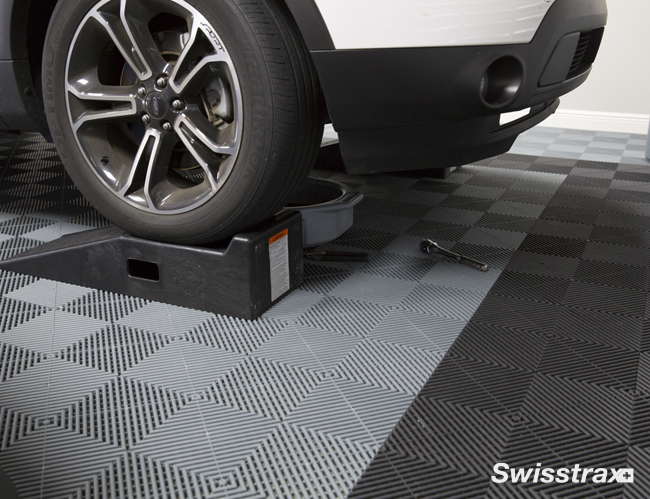
The hero of this layered system is Ribtrax PRO modular tiles from Swisstrax. At $8.58 per tile, they cover roughly one square foot each, snap together with no glue, and carry an 18-color palette that lets you build whatever pattern fits your space.
Ribtrax PRO is built from polypropylene copolymer with an internal channeling system on the underside. That channeling does two things at once: it lets dropped sweat, water, and floor cleaner drain through instead of pooling, and it lets the tile flex slightly under impact instead of cracking.
Tile size is 15.75 in by 15.75 in by 0.75 in thick. Weight is 1.47 lbs per tile. Each one snaps to the next with positive locking tabs that have been used in commercial showrooms, race shops, and car collector garages worldwide.
That is the surface layer. Now the cushion.
The Underlay That Saves Your Joints
Here is where most DIY gym floors fail. Modular tiles alone, while excellent for cars and rolling tool chests, aren't enough cushion under a 405-pound deadlift. You need a real impact layer underneath.
The Swisstrax Recycled Rubber Underlay at $178.50 is the missing piece. It rolls out flat over your concrete, the Ribtrax PRO tiles snap together on top, and now you have a sandwich that looks polished but performs like a real gym floor.
What the underlay actually does:
- Soaks up impact from dropped weights so the energy never reaches your concrete
- Damps sound so your 5 AM squat session does not echo through the bedroom above the garage
- Adds thermal insulation so the floor stops feeling like a glacier in January
- Reduces joint fatigue when you are standing for a long workout or a long brake job
Five pounds of recycled rubber isn't a marketing number. It's the layer that keeps your slab intact and your joints quiet.
Color Selection for a Dual-Use Floor
The unique thing about a modular tile floor is that you can map zones with color. Pick a darker base color for the parking footprint and a contrasting color for the gym zone.
A common layout for a 2-car garage:
- 12 ft by 20 ft gym zone in a lighter color (Pearl Silver, Cool Gray, or Arctic White) so dropped chalk and pre-workout spills are easy to see
- The remaining parking lane in a deeper color (Jet Black, Slate Gray) that hides tire marks and brake dust
- Two-tone border or checkered transition between the zones for a finished look
If you want the look of a high-end commercial gym, Ribtrax PRO Specialty Colors at $9.89 per tile add metallic, two-tone, and accent options. That extra $1.31 per tile gets you the showroom finish.
For a 400-square-foot two-car garage, you're looking at roughly $3,432 for full Ribtrax PRO coverage in standard colors, or about $3,956 in specialty. Add three rolls of underlay for the gym zone and you're around $3,968 to $4,492 for a gym-rated, car-rated, professional-looking floor.
That is a one-time spend. The same flooring will outlast at least two daily drivers.
Tile Pattern Ideas for the Gym Side
Layout matters. A flat single-color floor works, but you can do better.
Race-stripe pattern. Two long stripes in your accent color running the length of your lifting platform. Pulls the eye toward the rack.
Border-and-fill. Solid border in the accent, solid fill in the base color. Defines the gym footprint cleanly.
Diagonal accent. A 45-degree band of accent tiles cutting across the gym zone. Makes a small space feel bigger.
Logo inset. Logotrax Pro tiles let you drop a custom logo or design directly into the tile surface. A favorite for serious home gym builders who want a real branded space.
Pull up our Floor Designer and lay out your gym zone before you order. The tool calculates exact tile counts by color, including edge and corner pieces, so there are zero surprises at install.
What About Pure Rubber Mat Options
A common question: why not skip the modular tiles and just lay 3/4-inch stall mats from a farm supply store. They are cheap. They protect concrete. They handle drops.
Here is the honest answer. Stall mats work for a dedicated gym-only space. But the moment you want to park a car or a motorcycle on that floor, you've got a problem. Stall mats trap moisture against your concrete, develop a permanent rubber smell, and curl at the edges. They're also 4 ft by 6 ft slabs that weigh 100 lbs each, so the install is a back-breaker and you can't easily reconfigure the layout.
Modular tiles solve the dual-use problem. The Ribtrax PRO and underlay sandwich gives you barbell-ready cushion in the gym zone and car-ready surface everywhere else. When you want to reconfigure for a bigger lifting platform, you pop tiles up and snap them down somewhere else in 20 minutes.
For a gym that doubles as a garage, modular wins. For a gym that will never see a car, stall mats are fine but they look like stall mats.
Storage Solutions Above the Lifting Zone
A real garage gym has plates, bars, kettlebells, dumbbells, bands, jump ropes, foam rollers, a sled, ab wheels, and sometimes a bench or two. That is a lot of gear to keep organized in a space that also has to fit a car.
Get it off the floor. Two SafeRacks 4 ft by 8 ft Overhead Storage Racks at $410 for the pair gives you 64 square feet of ceiling-mounted storage that holds up to 600 lbs per rack. Park your offseason gear, holiday boxes, and sport equipment up top, and keep the floor clear for actual training.
For dumbbells, plate trees, and bar storage, a SafeRacks Mobile Workbench on heavy casters lets you stage a workout zone, then roll the whole thing against the wall when the car comes back in.
The whole point of a garage gym is flexibility. Build it so you can transition the space in five minutes.
Subfloor Considerations Before You Install
Two things matter before you snap a single tile.
Slab condition. Ribtrax PRO doesn't need a perfect slab. The channeling system on the underside lets it sit flat over minor imperfections, hairline cracks, and small dips. But major cracks, heaving, or pooling water need to be addressed first. Patch the crack, level the heave, fix the drainage.
Moisture. Concrete sweats. If your slab gets damp under cars or after a hose-down, you want airflow under the floor. The Ribtrax PRO channeling handles this naturally because the tiles do not seal the concrete. Air moves underneath, moisture evaporates out the seams. No mold, no smell.
If you're working over a slab that has had paint or epoxy applied, scrape any flaking sections and let the surface fully cure before installing tiles. The tiles will sit fine over solid epoxy. They won't sit fine over peeling epoxy.
For a step-by-step on the install itself, read our Swisstrax floor tile installation guide.
What This Floor Costs Versus What It Replaces
Skeptical about the price tag. Let's run the numbers against the alternatives.
- Epoxy coating. $4 to $7 per square foot installed. So $1,600 to $2,800 for a 400 sq ft 2-car garage. Cracks if your slab moves. Slick when wet. Strips paint off your shoes. Cannot be reconfigured. No cushion for gym drops.
- Polished concrete. $3 to $8 per sq ft. Beautiful. Zero cushion. Brutal on joints. Stains over time.
- Stall mats. Roughly $50 per 4 ft by 6 ft mat. Cheap but ugly, smelly, and immobile.
- Cheap interlocking foam. $1 to $2 per sq ft. Compresses to nothing in three months under heavy use.
- Layered Ribtrax PRO and rubber underlay. Roughly $10 per sq ft for the gym zone, $8.58 per sq ft for the parking zone. Reconfigurable. Drainable. Handles drops. Handles cars. Lasts 20+ years.
For the gym builder who also wants to park a car, there is no other product on the market that does both jobs at the level of the Ribtrax PRO sandwich.
Making the Call
Build the floor first. Everything else in the garage gym -- the rack, the bench, the bar, the storage -- gets easier when you have a surface that handles abuse and looks finished.
Start with Ribtrax PRO standard colors at $8.58 per tile, add Recycled Rubber Underlay at $178.50 for the gym zone, and stage the rest of the gear up on SafeRacks overhead storage so the floor stays clear.
Pull up the Floor Designer to lay out your colors, Garage Builder to plan the equipment placement, and order your tiles direct. Free shipping nationwide on full orders. The floor will be on your concrete inside a week.
Your barbell, your knees, and your daily driver will all thank you.