How an Overhead Storage Lift Reclaims Your Garage Floor
Walk into most American 2-car garages and you'll see two things. A car parked in the driveway. And the spot where that car should be living, buried under bins of holiday decorations, camping gear, kid bikes nobody outgrew, and the boxes from the move five years ago.
Roughly a quarter of households can't fit a vehicle in a garage built to hold one. The space is there. The square footage is there. The stuff just won the war.
Standard overhead racks fix half of that. They bolt to the ceiling joists, hold 600 pounds of bins out of sight, and free up the floor underneath. They're a great answer until you actually need to grab the Christmas tree in December and you're balancing a full bin on the top step of an 8-foot ladder.
There's a better version of this. And it's the difference between storing things overhead and actually using what's stored up there.
The Ladder Problem Nobody Talks About
A standard 4'x8' overhead rack sits about 16 to 24 inches below your garage ceiling. In a garage with 9-foot drywall, that puts the rack platform around 7 feet off the floor. Doable with a step stool for a single light bin.
Now load it the way most people actually load it. Holiday decorations in the back. Kids' baby gear in the middle. Camping gear and tools you use every other weekend on the front edge. Once that rack is full and the front bins are pinning the back ones in place, getting to anything past the front row means hauling a real ladder, climbing up holding nothing, then dragging bins forward across plastic ribbing while standing on a rung.
That is how people fall in their own garage.
Worse, that's how people just stop using overhead storage. They load it up once, can't easily access anything, and the floor clutter creeps right back. Bins migrate down because reaching them up there became too much trouble.
What a Hand-Crank Lift Actually Does
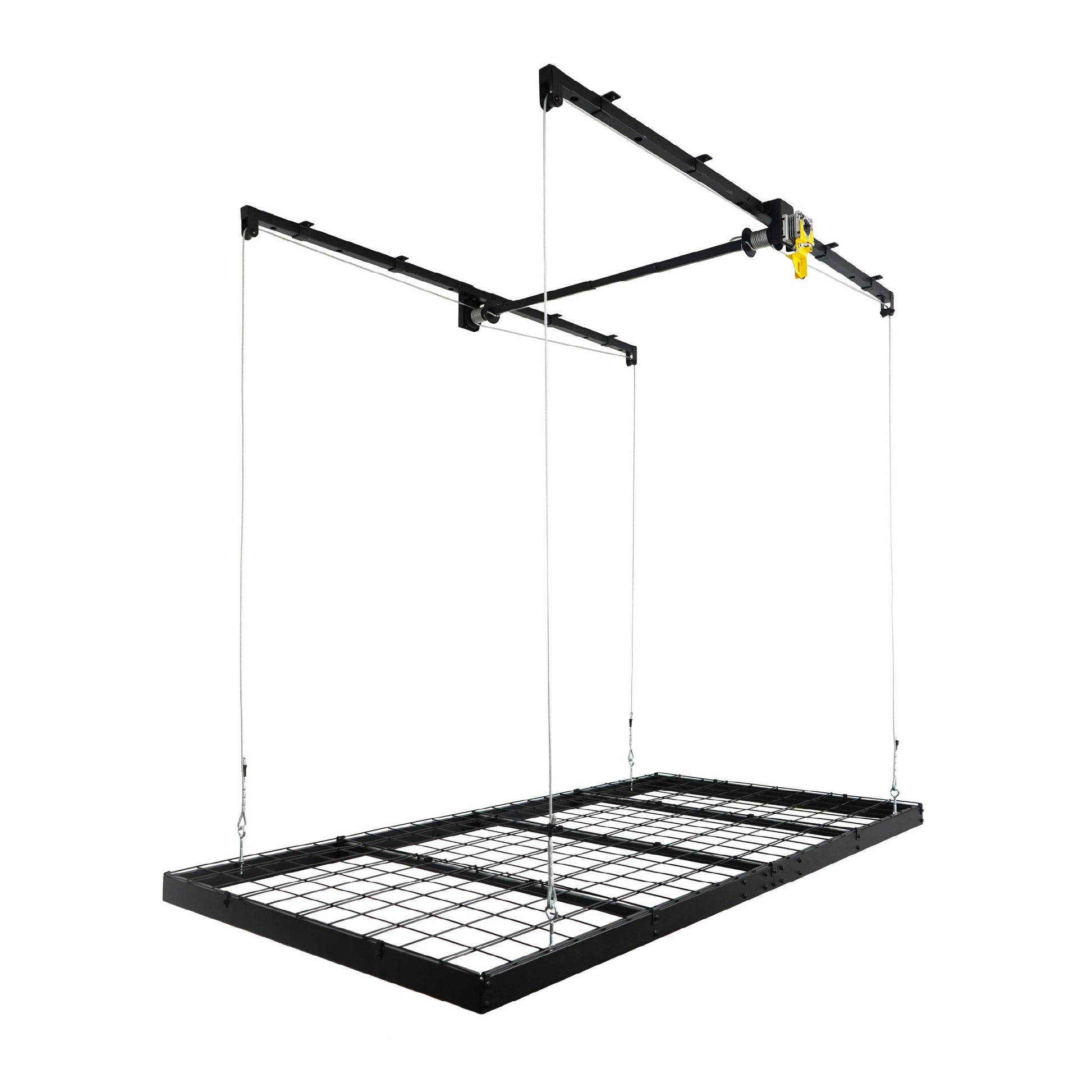
The SafeRacks 4'x8' Overhead Storage Lift solves this with a steel cable system and a hand crank. The platform itself is the same 4-foot by 8-foot footprint as a standard ceiling rack. Same 600-pound capacity. Same heavy-gauge steel construction.
The difference is what happens when you want your stuff back.
You walk over. You grab the crank handle. You spin it. The platform comes down on four steel cables, slowly and evenly, until it hits whatever height you want. Chest height. Waist height. The floor. Whatever's comfortable for the bin you're reaching for.
You load or unload. You crank the platform back up against the ceiling. Done.
No ladder. No climbing while holding 40 pounds of bin. No reaching past the front row to get to the back. The whole platform comes to you, every bin equally accessible, and goes back when you're finished.
The Specs That Matter
Here's what the lift actually offers, model SR-4X8-LIFT:
- Platform size: 4 feet by 8 feet (32 square feet of storage)
- Weight capacity: 600 lbs evenly distributed
- Vertical travel: Up to 9 feet from ceiling to floor
- Mechanism: 4-cable hand-crank system with built-in safety brake
- Mounts to: Ceiling joists or solid concrete ceilings (24-inch joist spacing)
- Construction: Heavy-gauge steel powder-coated white
- Price: $499.99 with free nationwide shipping
The 9-foot travel is the part that matters. Most home garages have 8 to 10 feet of ceiling clearance, which means the platform can drop all the way to the floor in nearly any garage. You don't need a tall garage. You don't need a workshop ceiling. The lift works in standard suburban builds.
The hand crank is geared so a 600-pound load lowers in about 3 to 4 minutes of slow, steady cranking. There's no motor to fail, no battery to charge, no electrical work required. Just the crank, the cables, and the brake.
Where It Goes in the Garage
The placement decision is mostly about your car's parked footprint and your ceiling joist direction.
Run a tape measure with your car parked where it normally sits. The lift can mount directly above the engine bay, the trunk, or anywhere your vehicle isn't. The standard mount runs the long axis of the rack perpendicular to the ceiling joists, which means you need to know which way your joists run before you order. A stud finder takes care of that in 5 minutes.
The lift comes with all the lag bolts and ceiling brackets needed for a standard wood-framed ceiling. For a finished garage with drywall, you'll mark the joist locations, drive the bolts through the drywall directly into solid wood, and the rack does the rest.
For garages with finished concrete ceilings (rare in residential builds, common in townhouses and converted spaces), you'll need concrete anchors instead of lag bolts. SafeRacks publishes hardware specs for both setups.
If you want to plan how the lift fits with the rest of your garage build, our Dream Garage Builder lets you drop in storage, lifts, and flooring at scale before you commit to anything.
What Goes On It (and What Doesn't)
The 600-pound capacity is generous. Real-world loads people store on a 4x8 lift:
- Full bin sets of seasonal decorations (8 to 12 standard plastic totes)
- Camping gear: tents, sleeping bags, coolers, camp stoves, folding chairs
- Kids' outgrown gear: car seats, strollers, baby furniture
- Sports equipment: skis, boards, bikes (lighter ones), golf clubs
- Tools you use less than once a month
- The boxes from when you moved that you swear you'll go through
What doesn't belong on overhead storage of any kind:
- Anything heavier than 50 pounds in a single bin (top-heavy, harder to manage)
- Anything liquid that could leak (paint, solvents, fluids)
- Anything you need every day (just put that on a wall shelf)
- Anything pressurized or flammable (propane, gasoline, aerosols)
For everyday tools and frequently used items, a wall-mounted system works better. The lift is purpose-built for the seasonal and bulky stuff that takes up floor space the rest of the year.
Lift vs. Standard Rack: When to Pick Which
We carry both. The math is straightforward.
Pick the standard 4'x8' Overhead Rack at $209.99 if your overhead storage is mostly stuff you access twice a year and you don't mind a ladder for two trips. Holiday decorations only? The standard rack does the job for half the price.
Pick the 4'x8' Overhead Storage Lift at $499.99 if you'll be accessing your overhead storage more than once a season, if you have older parents or shorter family members who can't safely use a tall ladder, or if you're storing the kind of mixed gear (camping in spring, kids' gear year-round, tools occasionally) where the front-bin-blocking-back-bin problem actually hits you.
For garages where one rack isn't enough, the 4'x8' + 4'x6' Bundle at $349.99 covers more square footage cheaper than two standalone racks.
If you want a full breakdown of every SafeRacks model side by side, our SafeRacks comparison guide lays out every option by capacity, size, and price.
Installation: Day Project, Not Weekend Project
Two adults can install the lift in a Saturday morning. Three to four hours start to finish, including unboxing, marking joists, drilling pilot holes, mounting the brackets, threading the cables, and load-testing the platform.
The hardest part is the marking. You need to find the ceiling joists, confirm spacing, and mark the four mount points so the platform hangs level. Anyone who has hung drywall or installed a ceiling fan can do it.
The lift ships flat in two boxes. You'll need a stepladder, a stud finder, a drill with a wood-bit set, a level, a tape measure, and a socket wrench. SafeRacks includes the lag bolts, brackets, cables, and crank assembly. They do not include the lifting equipment to actually get the platform up to the ceiling for installation -- two people lifting from below works fine, but a third helper holding the platform level while the first bolts go in makes life easier.
SafeRacks backs the system with a 10-year warranty. The cables are rated for 5,000+ cycles, which works out to roughly 100 years of monthly use.
What Changes When the Floor Comes Back
This isn't really about the lift. It's about what the floor looks like after the lift is installed and loaded.
A 4'x8' platform takes 32 square feet of floor clutter and moves it overhead. In a 2-car garage with one lift, that's roughly the difference between "we park one car outside" and "both cars go in the garage where they belong." Add a second rack or upgrade to a Swisstrax modular floor under everything and you have a garage that looks intentional instead of a holding pen for things you couldn't throw away.
The standard 2-car garage is 24 feet wide by 22 feet deep. That's 528 square feet of usable floor space if you reclaim every inch from clutter. Two parked vehicles take roughly 320 square feet. The remaining 200 square feet is yours -- workbench, lift, tool chest, fridge, whatever. But only if you actually move the seasonal stuff overhead and keep it accessible enough that you don't quit using the system after one year.
The lift is the part that keeps you using the system.
Get Your Floor Back
Most garage organization advice tells you to declutter first. Sort your stuff. Throw things away. Make hard decisions about what stays.
That's good advice. It's also the advice nobody follows, because the bins are full of things you actually want, and standing in a hot garage in July sorting them is nobody's idea of a Saturday.
The faster path: get the bins off the floor and onto a system that lets you access them without breaking your neck. The SafeRacks 4'x8' Overhead Storage Lift ships free anywhere in the United States, and it's the one piece of garage equipment that pays you back every time you walk into the garage and actually have room to move.
Pair it with a workbench, a wall storage system, and a real lift if you want to wrench on cars, and you have the start of a garage that works the way you always meant it to.