The Best Car Lift for Your EV at Home
Electric cars broke the home garage. Not on purpose, but the math changed. Your dad's two-post lift and the dusty jack stands in the corner were built around gas cars that weighed 3,500 pounds and had nice, accessible frame rails. Then a Tesla Model X rolled in at 5,400 pounds with a battery pack the size of a mattress bolted to the floor, and suddenly the old gear doesn't fit.
EVs need their own lift. The wheelbase is longer, the curb weight is higher, and the lift points sit way out at the corners. So if you bought a Lightning or a Model 3 and you want to rotate your own tires without paying a shop $40 a corner, you need equipment that was actually designed for the car in your driveway.
That lift exists. It's the QuickJack 6000ELX, and at $2,325 it's the cleanest answer to a problem most lift makers ignore.
Why EVs Are Harder to Lift Than Gas Cars
Three things make an electric car a pain to get off the ground.
First, weight. EVs carry a battery pack that can run 1,000 to 1,800 pounds on its own. A Rivian R1S tips past 7,000 pounds. A Mustang Mach-E sits around 4,800. Even a "small" Model 3 is close to 4,000 pounds loaded. That's a lot more than the sedan your floor jack was rated for.
Second, the wheelbase. Electric platforms stretch the wheels to the corners to make room for the battery. A Model S runs a 116-inch wheelbase. The lift points end up spread far apart, near the very edges of the frame. A standard portable lift just can't reach them.
Third, the underside. That flat battery pan covers most of the floor, so there's no diving in with a jack under the diff or the subframe like you would on a gas car. You have to lift from the factory pinch-weld points, and you have to clear the pack without touching it.
Most lifts fail at least one of these tests.
The 6000ELX passes all three.
The QuickJack 6000ELX, Built for Long Cars
QuickJack made the 6000ELX for one reason. The rest of their lineup covered about 98% of cars on the road, and the longest EVs fell in the gap. Instead of telling those owners good luck, they built a frame long enough to fit them.
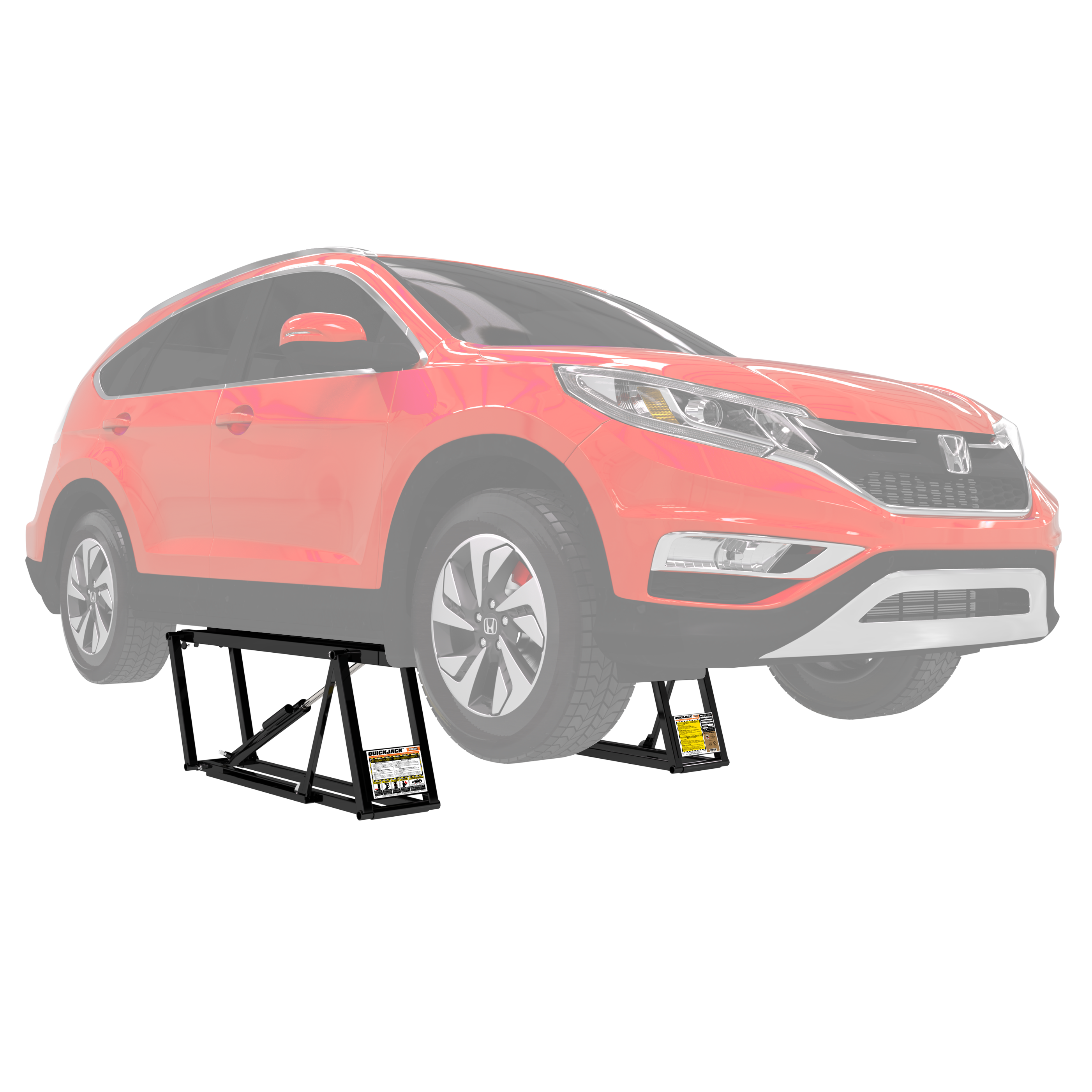
The numbers tell the story. The ELX gives you a maximum lift point spread of 76 inches, the widest in the QuickJack family. That's what lets it reach the corner lift points on a Tesla, a Lucid, or a long-wheelbase truck. The minimum spread drops to 53 inches, so it still works on shorter cars when you want to swap the lift between vehicles.
Capacity is 6,000 pounds. That covers the vast majority of EVs on the market -- every Model 3, Model Y, Model S, Mach-E, Ioniq 5, EV6, and most others fit with room to spare. The exception is the heavy stuff. A loaded Rivian R1T or a Hummer EV blows past 6,000 pounds, and for those you're looking at a bigger four-post setup. I'd rather tell you that straight than have you order the wrong lift.
Here's what makes it work in a real garage:
- Open-center design. No crossbar in the middle, so you get full access to the battery pan, the pinch welds, and the whole underside.
- Cantilevered frames. They're shaped so they rise without rubbing against your tires, which matters on cars with the wheels pushed out to the corners.
- Automatic safety locks. Two locking positions engage as the lift rises. Even if the hydraulics let go completely, the car stays put.
- 110V power. It plugs into a standard wall outlet. 1,100 watts, 10 amps, no electrician, no 220-volt circuit to run.
That last point is bigger than it sounds. A two-post lift means an electrician, a permit in a lot of areas, and a dedicated circuit. The 6000ELX plugs into the same outlet you charge a drill battery on.
It Disappears When You're Done
The thing nobody tells you about home lifts is the floor space tax. A two-post lift owns its bay forever. You build the garage around it.
The 6000ELX doesn't work that way. Each frame weighs 124 pounds and the lowered height is just 3.5 inches. When you're finished, you roll the frames against the wall and park your car right where the lift was. The garage goes back to being a garage.
That's the whole appeal of going portable. You get real lift height -- around 21 inches off the ground, enough to sit under comfortably and pull all four wheels -- without giving up the bay. If you've only got a two-car garage and you still want to park in it, this is the move. We get into the small-garage angle more in our portable car lift guide.
What You'll Actually Use It For
You don't need to be doing engine swaps to justify a lift. EVs create their own maintenance rhythm, and most of it happens at the wheels.
Tire rotations come up fast. Instant torque plus all that weight chews through tires, and a lot of EV owners are rotating every 5,000 to 7,500 miles to keep the wear even. At a shop that's $40 to $80 a visit. Do it at home and the lift pays for itself over the life of the car.
Then there's everything else. Brake inspections. Checking the underbody for road damage. Detailing the wheels and arches properly instead of half-reaching from a crouch. Swapping to winter tires in November and back in spring. Rotating to a track set if you autocross. All of it is faster, safer, and frankly more fun when the car's at chest height instead of on your back on cold concrete.
And it's safer than the alternative. A lift with mechanical safety locks beats a floor jack and a pair of stands every single time, especially under a 5,000-pound vehicle. Nothing about jack stands inspires confidence when a Model X is the load.
How It Stacks Up Against the Rest of the Line
The ELX isn't the only portable QuickJack. If your EV has a normal wheelbase, you might not need the extra length.
The 6000TL standard frame runs $1,925 and handles the same 6,000-pound capacity with a shorter lift point spread. For a Model 3 or a Bolt, the TL is plenty and saves you four hundred bucks. The ELX earns its premium specifically when the car is long -- a Model S, a Lucid Air, a full-size electric truck within the weight limit.
If you're cross-shopping portable lifts in general, our QuickJack vs MaxJax breakdown covers the two big names side by side. And for the wider view across two-post, four-post, and portable, the home garage lift buyer's guide lays out which type fits which garage.
But for an EV owner who wants one lift that fits the longest cars without the install headache? The 6000ELX is the one I point people to.
Getting Started
Measure your garage first. You want enough length to set both frames under the car with a few feet to walk around, and enough ceiling to stand the car up to working height. Most standard residential garages handle it fine since the lift only goes up about 21 inches.
After that it's plug-and-play. Set the frames at your car's lift points, plug into the wall, raise it, let the safety locks catch. Pull your wheels and get to work.
Browse the full QuickJack lineup to compare frames and capacities, or take a look at everything in our lift collection if you're still deciding what fits your build. Your EV doesn't have to be the one car you can't work on at home.