The Portable Car Lift Setup for Small Garages and Low Ceilings
Not every home mechanic has a 24-foot-wide shop with 14-foot ceilings. Some of us have a one-car attached garage with 8-foot drywall, a shared wall with the laundry room, and a landlord who would have a stroke if we bolted anything to the slab.
That was always the problem. The lifts everyone talks about -- the two-post and four-post monsters that fill gearhead Instagram -- need ceiling, they need concrete specs, and they need to be yours to install. If your garage is small, rented, or shared with a minivan and three bikes, those lifts may as well not exist.
So the weekend wrenching stayed on jack stands. Oil changes with your face three inches from the pan. Brake jobs done on your back, squinting at caliper bolts. Ringing up the drain plug through a flashlight held in your teeth.
There's a way out of that. And it doesn't involve pouring a new slab or moving.
What a Portable Lift Actually Is
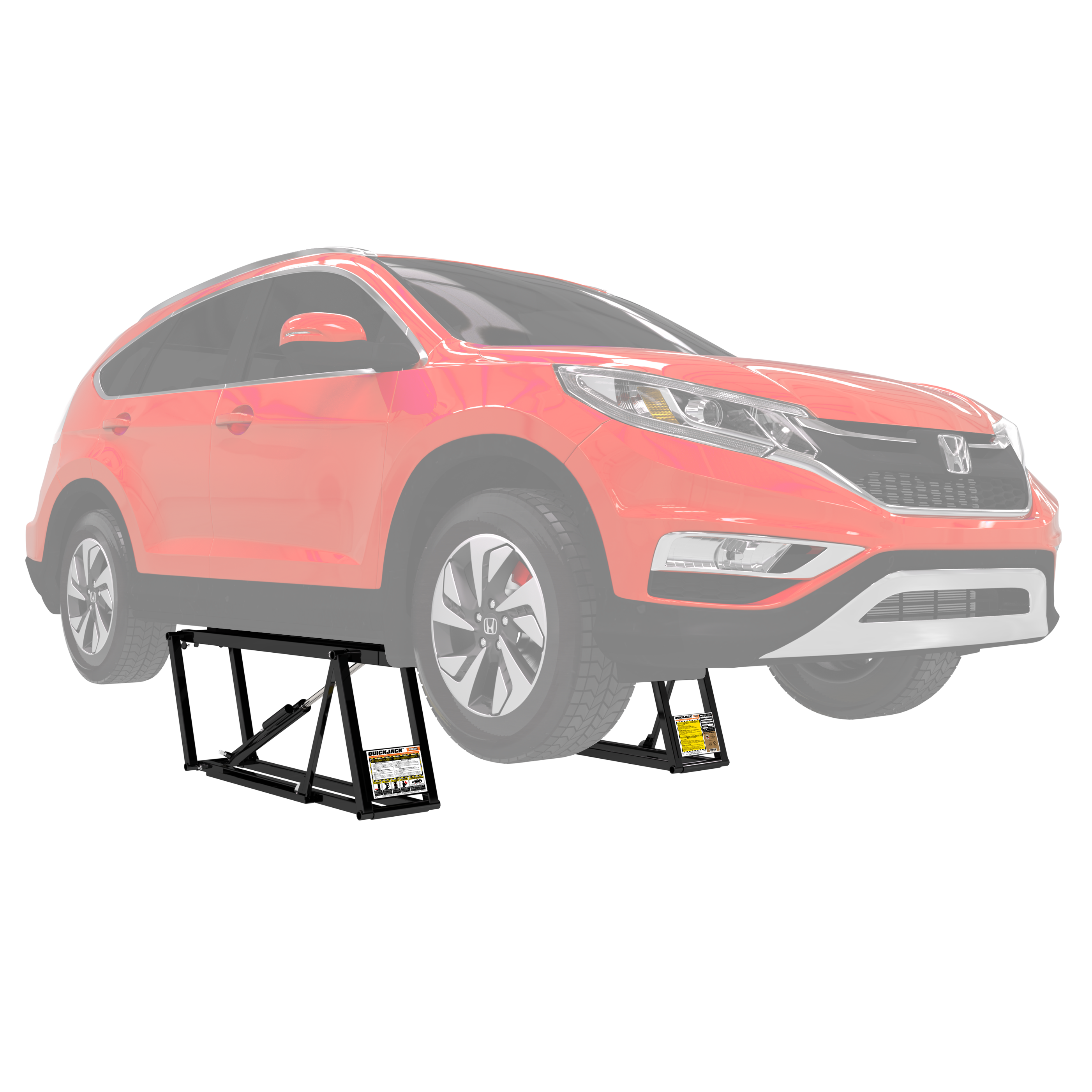
A portable car lift is a pair of small hydraulic frames that sit on your garage floor. You pull your car over them, line up the lift pads under the pinch welds or factory lift points, and the frames raise the whole car straight up.
The lift height is lower than a two-post. Most portables top out between 17 and 24 inches off the ground. That's not enough to stand under a car. But it's plenty to sit on a creeper, roll right under, and actually see what you're doing.
And when you're done, the frames come out. You coil up the hydraulic lines, park the unit against a wall, and you've got your garage back.
That is the key thing most people miss. A portable lift solves a storage problem as much as it solves a working-height problem.
Why Ceiling Height Stops Mattering
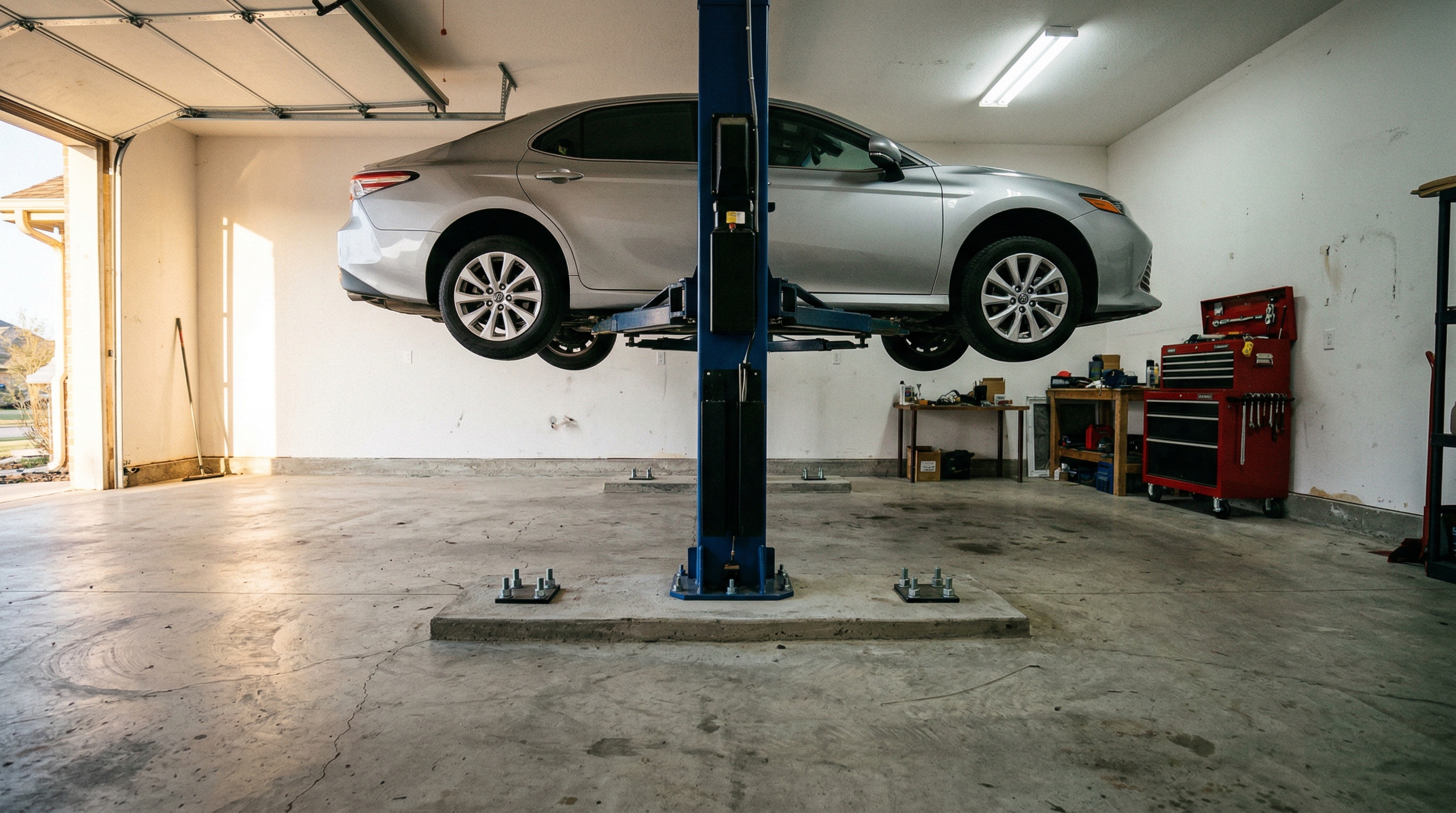
A BendPak two-post lift needs about 11 feet of ceiling minimum. A four-post storage lift with a full-size truck on top needs closer to 12. If you've got an 8-foot or 9-foot garage ceiling, that conversation is over before it starts.
A portable lift doesn't care. The car never leaves its wheels in the air higher than about two feet. You could run one of these in a ceiling with 7 feet of clearance and never come close to the header.
The same goes for garage doors, tracks, light fixtures, and the garage door opener rails. None of them are in the way, because none of them are up where the car is going.
If you want a full breakdown of what ceilings will and won't work for different lifts, we covered that in the garage ceiling height guide. For portables, the answer is just: yes.
The Concrete Question
Two-post and four-post lifts are bolted to the floor. That means your concrete has to be thick enough, cured enough, and rebar-reinforced enough to hold a few thousand pounds of torque when the lift gets loaded. Not every garage slab passes that test.
A portable lift doesn't bolt down. It sits on the floor. The load spreads across the two base frames, which means your slab only has to do what it was already doing: hold up a car that's parked on it.
Most homes built in the last 50 years have a garage slab that's fine for this. Level is more important than thick. If your concrete pitches hard toward the drain, you'll want to check level before lifting. Otherwise, you're good.
For the full specs on what a bolted-down lift needs, we went deep in the concrete floor requirements guide. For a portable, you can mostly skip that whole conversation.
The QuickJack 6000TL: Our Pick for Home Garages
When someone calls and says they want to get under their car but they rent, or they have 8-foot ceilings, or the garage has to keep working as a garage, we point them at the QuickJack 6000TL. It's the one we put in our own garages.
The numbers are simple:
- 6,000 pound lifting capacity
- 24 inches of lift height
- 30 seconds from ground to full height
- Standard 110V household outlet -- no dedicated 220V circuit needed
- 84 pounds per frame, so one person can move it
- Dual locking positions so the car sits on mechanical stops, not on hydraulic pressure
That 110V number is the one that sells most people. The heavier two-post lifts need a 220V line run from your panel, which is a whole electrician visit and permit conversation. The 6000TL plugs into the same outlet as your trickle charger.
The 6,000-pound capacity handles every daily driver, most full-size sedans, and the majority of light trucks and SUVs. If you drive a 3/4-ton work truck, you want to step up to a larger frame. For a Miata, a Civic, an F-150, a 4Runner, a Mustang -- you're well under capacity and the lift doesn't even breathe hard.
And the 30-second rise time is not a gimmick. That number matters the tenth time you set up and break down in a single weekend.
The Jobs This Opens Up
Once you have 24 inches of clear working height, the list of stuff you can do at home gets a lot longer:
- Oil and filter changes in 15 minutes instead of 45
- Transmission fluid drops
- Brake pad and rotor replacement, front and rear
- Exhaust work, from header flanges all the way back to the muffler
- Shock and strut inspection, sway bar bushings, endlinks
- Fuel filter replacement
- Tire rotation without a floor jack dance
- Undercarriage rust prevention, rust repair, underbody coating
- Diff fluid, transfer case fluid, any gearbox drop
Shop labor in most of the country runs $150 to $200 an hour. The 6000TL pays for itself in 15 to 20 of those jobs. Most people hit that in the first year.
What a Portable Won't Do
Worth being honest here. A portable lift is not a service lift. It's not the right tool if you want to pull a transmission, drop a K-member, or do a full exhaust swap with the pipes off the car. You need height that a portable doesn't give you.
It's also not a storage lift. You can't park a car on a portable and fit another car underneath. That's what a 4-post lift is for, and you need the ceiling and the footprint to run one.
What the 6000TL does is give you enough room to do 90 percent of the maintenance and repair work that shows up on a normal car. Fluids, brakes, exhaust clamp jobs, suspension inspection, anything that happens within arm's reach of the undercarriage. For the weekend wrench, that's the sweet spot.
If you're still weighing portables against each other, the QuickJack vs MaxJax comparison breaks down where each one wins.
Renters, This Is Your Lift
One more reason this setup matters. Plenty of people wrench on their own cars while renting a house, a duplex, a townhouse with an attached garage, or an apartment with a private bay.
You can't bolt anything to the floor. You can't run new circuits. You can't drill the wall to mount air lines. All the advice online assumes you own the place.
The 6000TL doesn't change a single thing about the garage. It sits on the floor. It plugs into an outlet. When the lease is up, it goes in the back of the truck with you. No patches, no holes, no explaining anything to the landlord.
That's a real door opening up for a lot of people who thought a home garage lift was never going to be in the cards.
Setting One Up in Your Garage
There isn't much to set up. The 6000TL ships in two frames and a power unit. You unbox it, connect the hydraulic lines between the two frames, plug the power unit into a 110V outlet, and you're ready to lift.
The first time you position the frames under a car, do it with the car on the ground and take your time. Every vehicle has specific pinch weld or frame lift points -- check the owner's manual or the Bentley for your specific car. Once you know where they are, placement becomes second nature by the third or fourth use.
Block wheels before you lift. Always. The parking brake isn't a lift safety, and neither is leaving it in gear.
Work under a car that's resting on the mechanical locks, not on hydraulic pressure. This is the same rule as any lift, and the 6000TL makes it easy with its dual locking positions.
Beyond that -- roll a creeper under, grab your tools, and get to work on stuff you used to pay someone else to do.
Ready to see the 6000TL up close? The full product page has every spec, the install video, and our current pricing: QuickJack 6000TL Portable Car Lift. And if you're still figuring out what the rest of the garage should look like, the garage builder lets you drop one in and see how it fits.