Double Your Garage Parking With a 4-Post Lift
Your daily driver is in the driveway. Your project car is eating up half the garage. The wife's SUV has no home. And every time you want to pull the Mustang out, you're playing a six-move chess match with three vehicles.
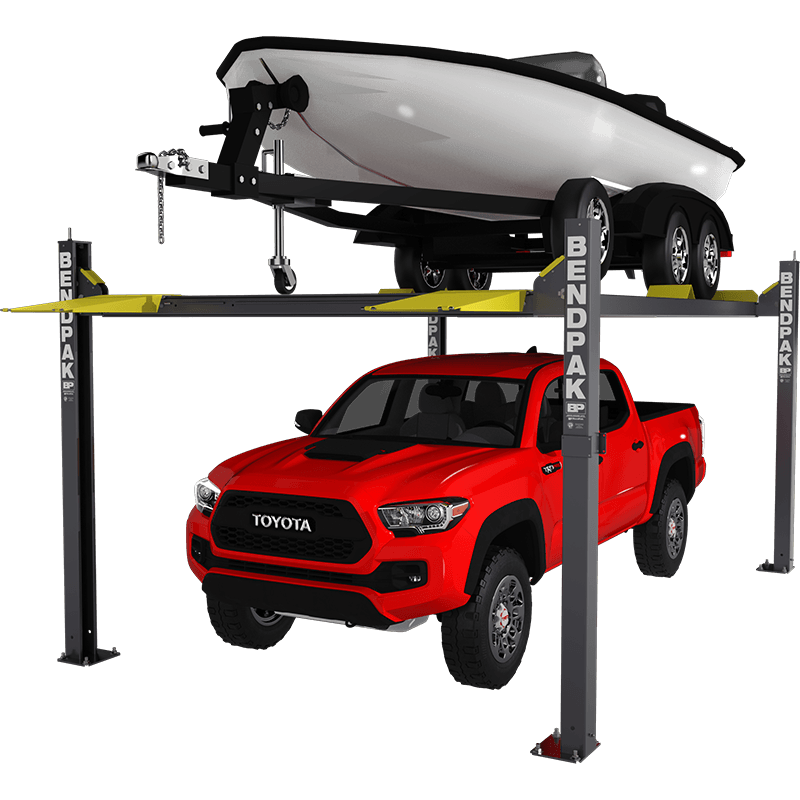
There's a fix for this that doesn't involve pouring a new slab or building an addition. A 4-post lift stacks one car on top of another in the same footprint. Two cars. One parking space. And when you're ready to drive the one on top, you lower it in about 45 seconds.
This is the single biggest space hack in home garage ownership. And it's why more collectors, enthusiasts, and regular two-car families are putting one in every year.
What a 4-Post Parking Lift Actually Does
A 4-post lift is exactly what it sounds like. Four steel columns, two runway rails the car drives up onto, and a hydraulic system that raises the whole platform straight up.
The vehicle sits on its own wheels on the runways. You drive on, raise the lift, park another car underneath. That's it.
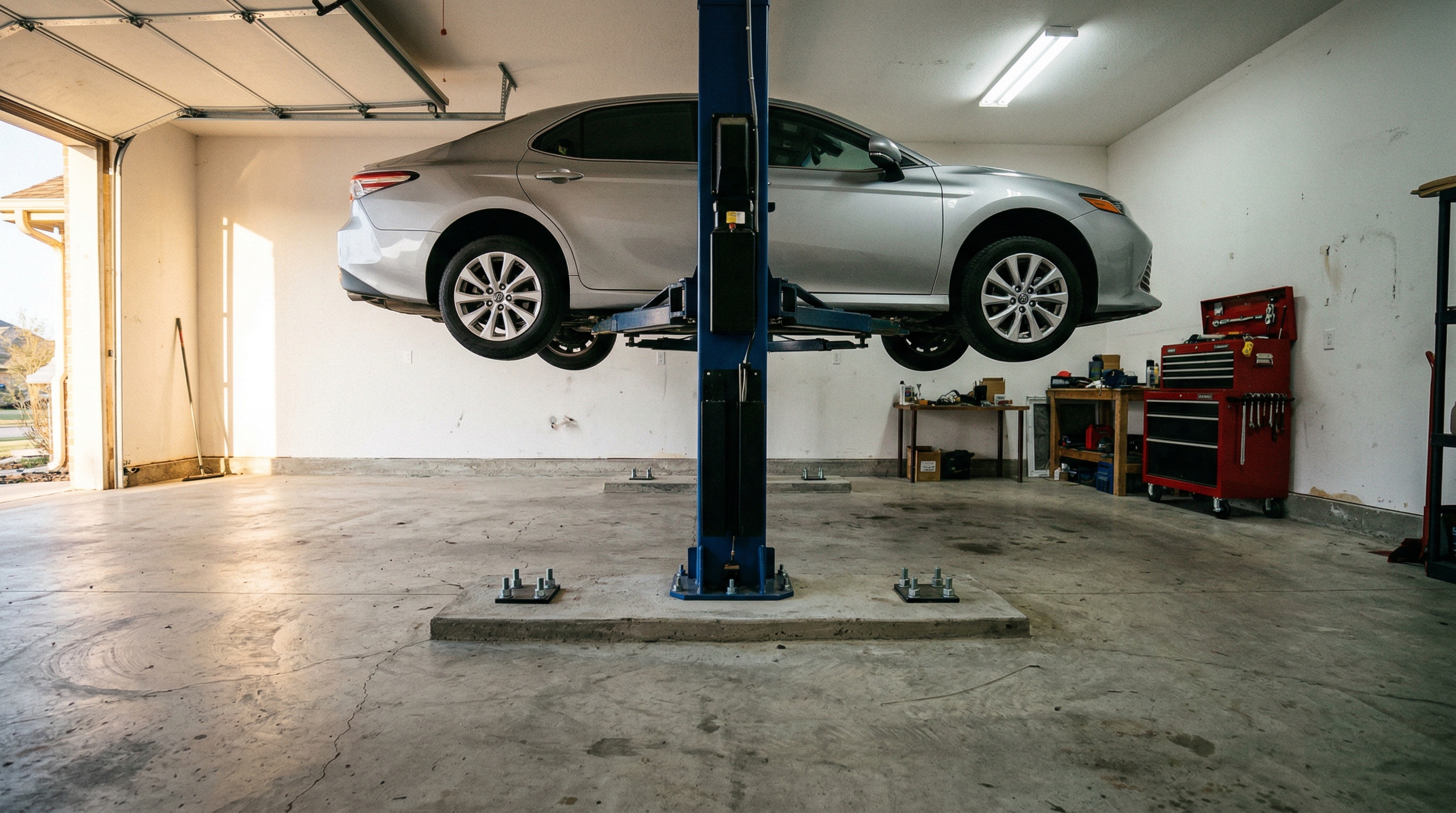
This is different from a 2-post lift, which grabs the frame of the car and holds it in the air by its pinch welds. A 2-post is a service lift. You use it to work under the car. A 4-post can do service work too with optional rolling bridge jacks, but where it really shines is storage and parking.
If your goal is stacking cars to reclaim garage floor space, you want a 4-post. Every time.
The Math on Doubling Your Capacity
Most people miss this when they first consider a 4-post lift. You're not really adding a parking space. You're adding every parking space you already had.
A standard two-car garage has room for two cars, obviously. Drop a 4-post lift into one of those bays and now you can park four. A three-car garage becomes a six-car garage. A detached shop with room for two becomes the setup your buddies text you about.
The cost of building a new garage bay runs $30,000 to $60,000 once you factor in foundation, framing, roof, doors, permits, and electrical. A home 4-post lift starts around $3,500 and a premium model that'll handle a full-size truck lands around $6,500. You do the math.
And unlike an addition, the lift comes with you when you move. Unbolt the feet from the concrete, disconnect the power, break it down, and it's going in the moving truck.
The BendPak HD-9XW: The Sweet Spot for Home Storage
If you're looking at 4-post lifts for a home garage, the BendPak HD-9XW is the one we point most customers toward. It's $6,495. It holds 9,000 pounds. It gives you 82 inches of rise out of the runways.
Those three numbers matter.
The 9,000-pound capacity covers everything in a normal garage. Half-ton pickup. Full-size SUV. Performance sedan. Lifted Jeep. You're not tiptoeing around weight limits with this lift. The 2024 Ford F-150 weighs around 4,700 pounds. A Tahoe is closer to 5,800. You have headroom.
The 82 inches of rise is what separates a storage lift from a frustrating storage lift. That's the height from the floor to the top of the runway when the lift is fully raised. You can walk under the top car without ducking. You can put a second vehicle under it that's 6 feet tall and still have clearance for the runway itself above. A first-gen Bronco or an older 4Runner fits underneath comfortably.
The HD-9XW is standard width, which means it handles full-size trucks and wide SUVs without anyone worrying about clipping a mirror on the post when they drive on. BendPak builds these in Santa Paula, California, and every lift is certified to the ANSI/ALI ALCTV-2011 safety standard. That is the highest third-party safety rating any automotive lift can earn in North America. Most lifts on the market don't carry it.
Factory-direct pricing, free shipping nationwide, and a warranty BendPak actually trademarked because they back it. That's the package.
Ceiling Height: Check This Before You Do Anything Else
This is where most home lift plans die.
A 4-post lift needs ceiling height. The HD-9XW needs around 132 inches (11 feet) of clearance to fully extend with a vehicle on top. You can run it shorter with a lower vehicle up top, but the math matters.
Here's the formula that actually works. Take the height of the tallest vehicle you want to park on top. Add the height of the vehicle you want to park underneath. Add about 6 inches for the runway itself. Add another 4-6 inches of buffer. That's the minimum ceiling height you need.
Example. Car on top is a Corvette at 48 inches tall. Car underneath is a truck at 78 inches tall. 48 + 78 + 6 + 4 = 136 inches, or 11 feet 4 inches. Your ceiling needs to be at least that tall.
Most standard American homes have 8-foot garage ceilings. That won't work for storage stacking. 9-foot ceilings get you tight with low vehicles only. 10 to 12 feet is the range where a 4-post stacker actually works. If you have 14-foot ceilings or taller, you're in the clear for anything.
Measure before you order. Not after.
For a full breakdown of the ceiling math and why it matters for every lift style, read our garage ceiling height guide.
Concrete, Electrical, and the Rest
A 4-post lift doesn't need as much from your concrete as a 2-post does, but it still needs real concrete. BendPak calls for a minimum of 4 inches of steel-reinforced concrete at 3,000 PSI minimum. Most residential garage slabs hit that spec, but old garages from the 70s or earlier sometimes don't. A core sample from a local concrete contractor runs about $150 and tells you everything you need to know. Worth it.
Electrical is simpler than people expect. The HD-9XW runs on a standard 220V single-phase circuit, which is the same power your clothes dryer uses. A qualified electrician can run a dedicated circuit to your garage for $300 to $800 depending on how far the panel is.
For the full breakdown on what your floor needs to handle, check the concrete floor requirements guide.
You'll also want a flat floor. A slight slope is fine, but if your garage slopes toward a drain by more than a few degrees, plan on shimming the lift feet or pouring a level pad. A laser level from the hardware store tells you what you're working with in ten minutes.
Who Should Actually Buy One
Let's be honest. A 4-post lift isn't for everyone.
Buy one if you have three or more vehicles, a project you want to keep out of the weather, or a seasonal toy that sits 8 months a year. Buy one if you have an enthusiast hobby and you're tired of renting outdoor storage. Buy one if you want to pull your wife's car in the garage every winter without moving six things.
Don't buy one if your ceiling is 8 feet and you can't change it. Don't buy one if you have one car and plenty of space. Don't buy one if your garage floor is cracked concrete from 1962 and you haven't checked its thickness.
The upgrade makes sense when you're stacking. Not when you've just got one car.
When You Need to Stack Three
If two cars stacked isn't enough, BendPak makes the HD-973PX Tri-Level Parking Lift. That's three vehicles in the footprint of one. It runs $22,495 and it needs about 14 feet of ceiling clearance, so it's a commitment. But for serious collectors with six to eight cars and a shop they actually want to use, the tri-level changes the economics of garage space completely.
We've had customers in 40x60 shops fit 12 cars across four HD-973PX lifts. That's a showroom-grade car collection in a building smaller than some garages.
If you're stacking two, the HD-9XW is the move. If you're stacking three, the tri-level is the only game in town.
Planning Your Setup
Before you order, map out your garage. Measure the width, depth, and ceiling height at the lowest point, not the peak. Check where the garage door tracks run. Most overhead doors have track assemblies that stick down 8 to 12 inches inside the garage, and the lift has to clear those.
Then think about how you'll actually use it. Which car goes on top. Which car lives underneath. How often will you be swapping them. A daily driver on top and a project car underneath is a bad setup because you're raising and lowering every day. A seasonal toy on top and a daily underneath is the sweet spot.
You can also see the whole thing in 3D before you commit. Drop a 4-post lift into our garage builder and place your actual vehicles on it. It shows you exactly how much ceiling clearance you need for your own cars.
And if you're still torn between service and storage, compare 2-post vs 4-post lifts head-to-head.
The 4-post parking lift is the closest thing to a cheat code in home garage building. Fit two cars in the space of one. No permits. No contractors. No addition. Just the best $6,500 you'll spend on your garage.
Want to see what your setup could look like. Browse the BendPak 4-post lineup or jump straight to the HD-9XW and see if the numbers work for your garage.