2-Post vs 4-Post Car Lift: Which Should You Buy?
This is the most common question we hear from home garage owners shopping for their first vehicle lift. Both types are proven, safe, and available in the same capacity ranges. The difference comes down to how you plan to use the lift: primarily for maintenance and repair, or primarily for vehicle storage.
This guide compares the two types across every dimension that matters for a home garage installation.
How Each Type Works
2-Post Lift Operation
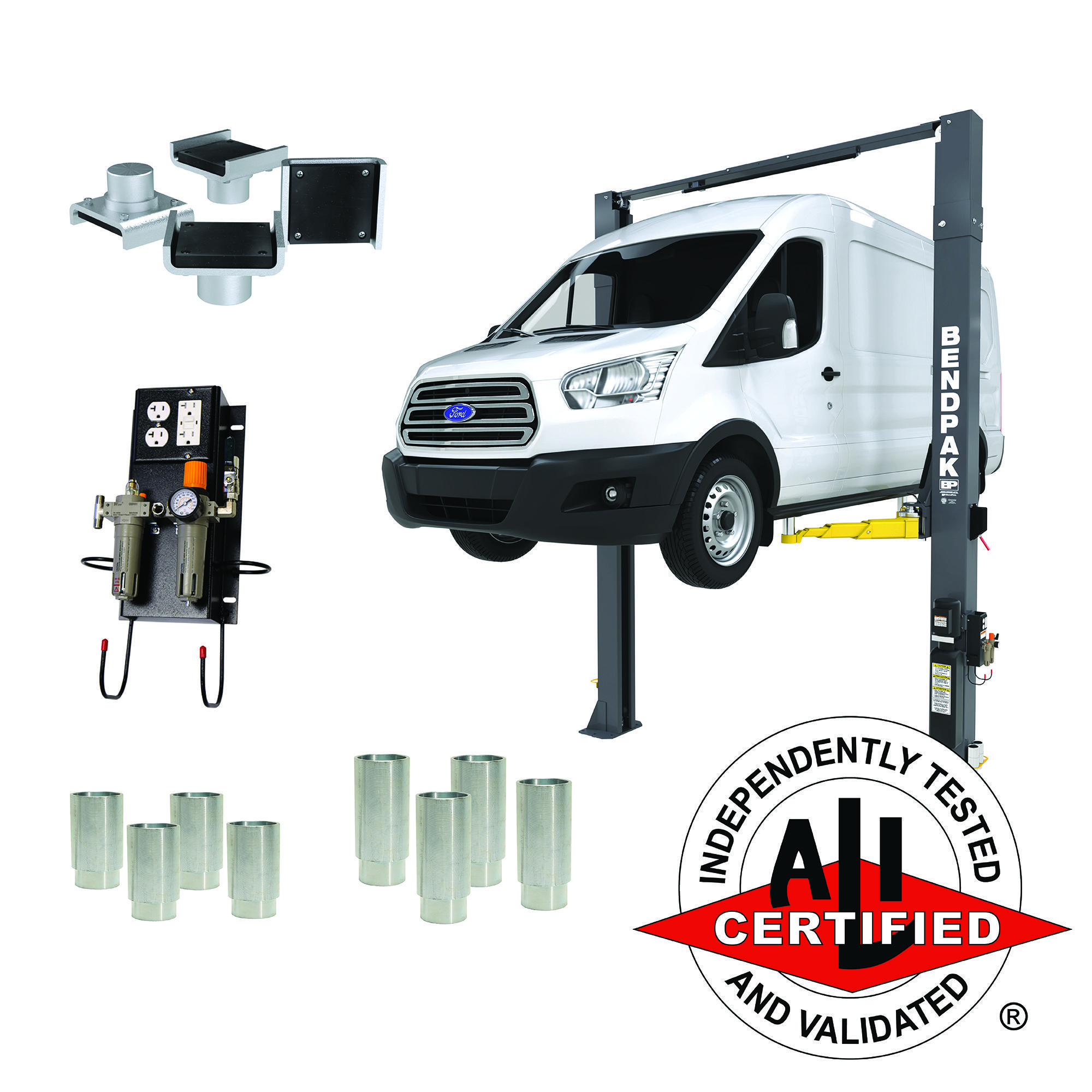
A 2-post lift has two vertical columns positioned on either side of the vehicle. Four adjustable swing arms extend from the columns and cradle the vehicle at its designated lift points (frame rails, pinch welds, or manufacturer-specified locations). A hydraulic pump raises the arms via cables or chains inside the columns.
The vehicle is suspended in the air with all four wheels hanging free. This provides complete, unobstructed access to the entire underside of the vehicle.
4-Post Lift Operation
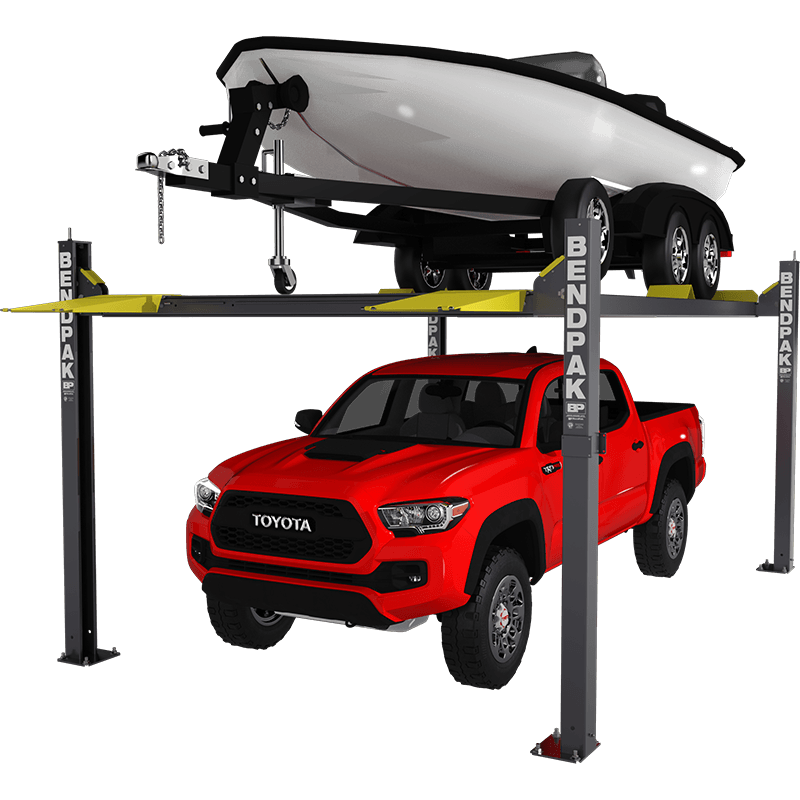
A 4-post lift has four vertical columns connected by two long runways (ramps). You drive the vehicle onto the runways, and the entire platform rises hydraulically. The vehicle sits on its tires on the elevated runways.
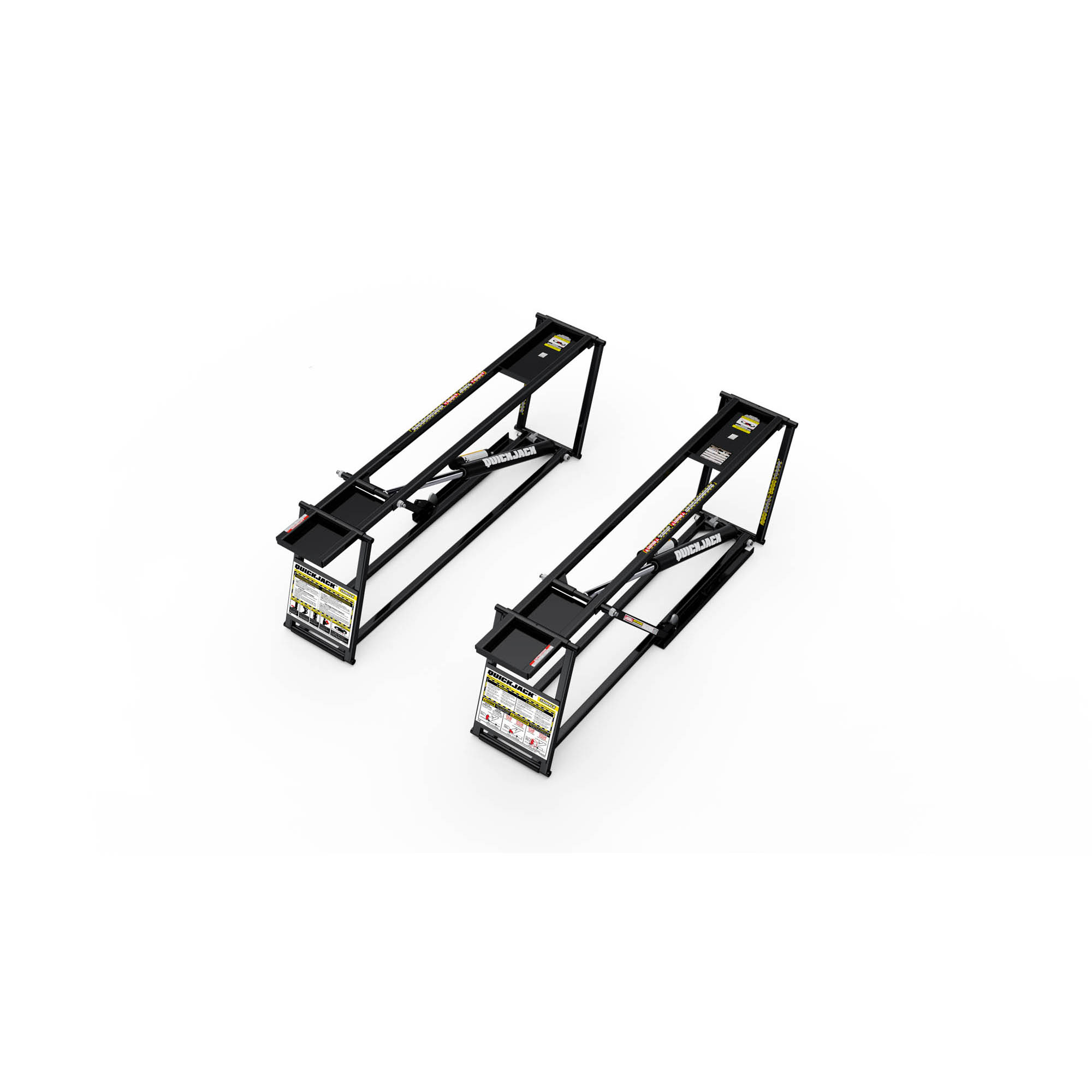
With the standard configuration, the wheels remain on the runways. For wheel-off service, optional rolling bridge jacks (like the Dannmar DJ-4500) lift the vehicle off the runways by the frame, freeing the wheels.
Comparison Table
| Feature | 2-Post Lift | 4-Post Lift |
|---|---|---|
| Undercar access | Complete -- all 4 wheels free | Limited unless bridge jacks added |
| Vehicle loading | Position arms under lift points | Drive on (easiest) |
| Vehicle storage | No (vehicle must be removed) | Yes -- park a car underneath |
| Floor anchoring | Required (heavy-duty anchors) | Required (lighter anchoring) |
| Footprint | Compact (just two columns) | Larger (full vehicle length + columns) |
| Ceiling height needed | 11'6" - 15'+ | 11' - 14'+ |
| Typical capacity | 7,000 - 18,000 lbs | 7,000 - 14,000 lbs |
| Price range | $7,500 - $13,000+ | $8,500 - $10,000+ |
| Best for | Maintenance and repair | Storage and convenience |
Use Cases: Where Each Type Excels
2-Post Lift Use Cases
Brake jobs. With all four wheels hanging free, you have immediate access to every caliper, rotor, brake line, and ABS sensor without any additional setup.
Suspension work. Springs, struts, shocks, control arms, ball joints, tie rods -- all accessible at standing height without contortion.
Exhaust work. Full access to the exhaust system from manifold to tailpipe. Essential for header installations, catalytic converter replacement, and full system upgrades.
Transmission service. Whether you are swapping a transmission or just servicing it, a 2-post lift gives you the room to work underneath with a transmission jack.
Oil changes and fluid service. Quick access to drain plugs, filters, and fill points.
Undercoating and inspection. The entire underside is visible and accessible for rust inspection, undercoating application, or detailing.
4-Post Lift Use Cases
Vehicle storage. This is the primary advantage of a 4-post lift. Raise one vehicle and park another underneath, effectively doubling your garage capacity. Car collectors use 4-post lifts to store multiple vehicles in a single bay.
Alignment work. The flat runway surface combined with optional alignment turn plates makes 4-post lifts the standard for alignment shops. If you do your own alignments, this is the way to go.
Drive-on convenience. No arm positioning, no lift point identification, no risk of incorrect placement. Just drive on and press a button.
Detailing. Raise a vehicle to a comfortable working height for washing, waxing, and detailing without full undercar access needs.
Tire rotations. With optional bridge jacks, 4-post lifts handle tire rotations efficiently.
Space Requirements
2-Post Lift Space
A 2-post lift has a surprisingly compact footprint. The two columns occupy about 3-4 square feet total. The vehicle bay itself is the only space needed.
Recommended bay size: 12 feet wide x 24 feet deep minimum
The width needs to accommodate the vehicle plus walking space on both sides. The depth needs to accommodate the vehicle plus room to open the hood and trunk.
Ceiling height: Most standard 2-post lifts need 11'6" to 12' of ceiling clearance. Extended-height models like the BendPak 10APX-181 need 15'+.
4-Post Lift Space
A 4-post lift occupies a larger footprint because the runways extend the full length of the vehicle. The four columns also consume more floor space than two.
Recommended bay size: 12 feet wide x 26 feet deep minimum
The extra depth accommodates the runway length plus approach ramps.
Ceiling height: Similar to 2-post lifts -- 11' to 14' depending on model and vehicle height.
Storage advantage: While the 4-post lift itself takes more space, it creates space by allowing a second vehicle to park underneath the raised vehicle. Net space gain: one full vehicle bay.
Price Comparison
BendPak 2-Post Lifts
| Model | Capacity | Price |
|---|---|---|
| BendPak 10AP-168 | 10,000 lbs | $7,545 |
| BendPak 10APX-181 | 10,000 lbs | $8,445 |
| BendPak HD-9AE | 9,000 lbs | $9,395 |
| BendPak HDS-14LSXE | 14,000 lbs | $13,095 |
BendPak and Dannmar 4-Post Lifts
| Model | Capacity | Price |
|---|---|---|
| BendPak HD-7500BLX | 7,500 lbs | $8,595 |
| BendPak HD-7PXW | 7,000 lbs | $9,695 |
| Dannmar D4-9 Package | 9,000 lbs | Contact for price |
| Dannmar D4-9X Package | 9,000 lbs | Contact for price |
Pricing is broadly comparable between 2-post and 4-post lifts at similar capacity levels. The 4-post models tend to cost slightly more due to the additional structural material (four columns and two runways vs. two columns and a crossbeam).
Additional Costs for 4-Post Lifts
To get wheel-off capability on a 4-post lift, you need rolling bridge jacks:
- Dannmar DJ-4500 -- 4,500-lb bridge jack
- Dannmar DJ-6000W -- 6,000-lb rolling bridge jack
These add $1,000 to $2,000 to the total investment. Without bridge jacks, a 4-post lift cannot do wheel-off work.
Accessibility and Ease of Use
Loading a Vehicle
4-post lift wins decisively. You drive the vehicle onto the runways and press a button. No arm positioning, no lift point identification, no risk of placing arms incorrectly. This makes 4-post lifts ideal for households where multiple people use the lift or where different vehicles are lifted frequently.
2-post lifts require knowledge of each vehicle's lift points. Placing arms incorrectly can damage the vehicle's body, rocker panels, or undercarriage. Once you learn the lift points for your specific vehicles, it becomes routine -- but there is a learning curve.
Daily Use
2-post lifts are faster for service work. Raise the vehicle, and you are immediately working with full access. No bridge jacks to position, no runways to work around.
4-post lifts are faster for storage. Drive on, raise, park another car underneath. Done.
Safety
Both types are equally safe when properly installed and maintained. Both use mechanical locks, equalization systems, and slack-cable detection. The key safety difference:
- 2-post lifts require correct arm placement. Incorrect placement is the most common cause of lift accidents.
- 4-post lifts have drive-on runways that eliminate arm placement errors, but the vehicle can roll off the runways if not properly chocked.
Decision Framework
Buy a 2-Post Lift If:
- Your primary goal is vehicle maintenance and repair
- You do not need to stack/store vehicles
- You want full undercar access without adding bridge jacks
- You are comfortable learning and positioning lift arms
- You want the most compact footprint
- You do brake, suspension, exhaust, or drivetrain work regularly
Our recommendation: BendPak 10AP-168 at $7,545 for the best balance of capacity, height, and value.
Buy a 4-Post Lift If:
- Your primary goal is vehicle storage (doubling parking capacity)
- You want drive-on convenience
- Multiple family members will use the lift
- You want to do alignment work
- You are willing to add bridge jacks for occasional wheel-off service
- Ease of use is more important than maximum undercar access
Our recommendation: BendPak HD-7PXW at $9,695 for the widest runways and best storage versatility.
Buy Both If:
If budget and space allow, the ultimate home shop has a 2-post lift for service and a 4-post lift for storage. Many serious enthusiasts end up with both over time -- a 2-post for the work bay and a 4-post in a second bay for the collection car or daily driver rotation.
The Verdict
For most home mechanics, a 2-post lift is the better choice. It provides superior undercar access at a comparable price, takes up less space, and handles every maintenance and repair task without compromise. If you are buying a lift to work on your cars, buy a 2-post.
For car collectors and multi-vehicle households, a 4-post lift makes more sense. The ability to double-stack vehicles is genuinely valuable when garage space is limited. The drive-on convenience is a bonus.
Use our Dream Garage Builder to place either type of lift in a 3D model of your exact garage dimensions. Seeing the lift in your space makes the decision much clearer.
Browse the full selection of BendPak lifts and Dannmar lifts to find the right model for your garage.