Concrete Floor Requirements for a Car Lift
Your garage floor is either ready for a car lift or it isn't. There's no faking it. A 2-post lift bolted into weak or thin concrete is a safety hazard, full stop. And yet this is the single most overlooked detail when people start planning a home garage lift install.
Before you pick a model, before you measure your ceiling, before you run a 220V circuit -- you need to know what's under your feet. The concrete slab in your garage has to meet specific thickness and strength requirements, or no reputable installer will touch it.
Good news: most residential garage slabs built after the 1980s will pass. But "most" isn't "all," and guessing is not an option when you're lifting 5,000 lbs of vehicle over your head.
The Numbers You Need to Know
Every major lift manufacturer publishes concrete specifications. They're not suggestions. Here's the baseline:
Minimum slab thickness: 4 inches
Recommended slab thickness: 6 inches
Minimum concrete strength: 3,000 PSI
Recommended concrete strength: 3,500 to 4,000 PSI
Reinforcement: Rebar or wire mesh preferred (not always required, but strongly recommended)
BendPak's official requirement is straightforward -- all their lifts must be installed on concrete only, with no installation on expansion seams, cracked, or defective concrete. That applies to everything from a BendPak 10AP-168 at $7,545 all the way up to their 18,000-lb commercial units.
A 4-inch slab at 3,000 PSI handles most lifts rated under 10,000 lbs. But if you're pouring new concrete or have the option to spec your slab, go 6 inches at 4,000 PSI. The cost difference on a typical 2-car garage pour is a few hundred dollars. The peace of mind is worth every penny.
Why Thickness and PSI Both Matter
People fixate on thickness and forget about PSI. They're two different measurements of two different things.
Thickness determines how deep the anchor bolts can bite. A 2-post lift uses 3/4-inch concrete wedge anchors that need to embed at least 3.5 to 4 inches deep. On a 4-inch slab, that's cutting it close. On a 6-inch slab, you've got comfortable margin.
PSI measures compressive strength -- how much weight per square inch the concrete can handle before it cracks or crumbles. A lift doesn't just push straight down. The anchor points create localized stress, and when the lift raises a vehicle, those forces concentrate at the base plates. Low-PSI concrete can crack around the anchors over time, and cracked concrete around a loaded lift anchor is exactly as dangerous as it sounds.
So you need both. A thick slab with weak concrete is a problem. A strong but thin slab is also a problem.
How to Check Your Existing Garage Floor
Most homeowners don't know their slab thickness or PSI rating off the top of their head. That's normal. Here's how to find out.
Checking Thickness
The easiest method is to look at an exposed edge. If your garage has a step-down to a driveway or if the slab edge is visible where the garage meets the foundation wall, you can measure directly.
No exposed edge? Drill a small test hole near where the lift posts would go. Use a masonry bit and drill until you punch through to the gravel or dirt below. Measure the depth. This takes five minutes and a hammer drill.
Checking PSI
This one's harder to DIY. The original PSI was determined by the concrete mix used during the pour. If you have your home's building plans or the original concrete invoice, the spec should be listed.
Without paperwork, you have two options. You can hire a concrete testing company to core-sample your slab -- they'll drill a small cylinder out and crush-test it in a lab. Costs around $200 to $400 depending on your area. Or you can use a Schmidt hammer (rebound hammer) for a rough estimate. Some lift installers carry these and will check as part of a pre-install inspection.
For homes built after 1990 with standard residential concrete, you're almost certainly looking at 3,000 PSI or higher. Older slabs and DIY pours are where things get uncertain.
2-Post Lifts: The Strictest Requirements
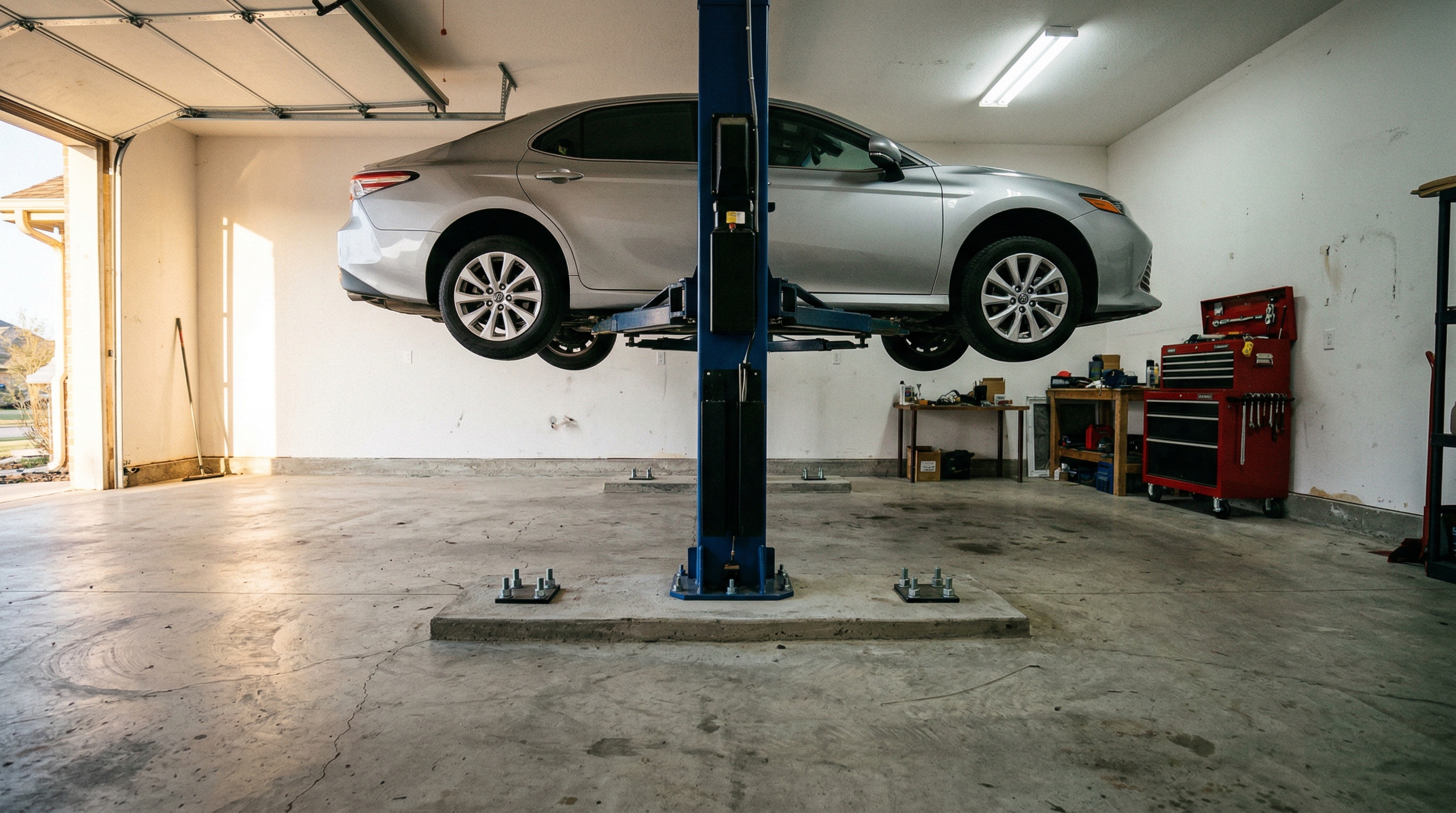
Two-post lifts put the most concentrated force on your concrete. All the weight channels through two narrow base plates and four to six anchor bolts per column. That's your entire vehicle balanced on a handful of connection points.
The BendPak 10AP-168 Pro Series is our go-to recommendation for home garages with standard ceiling heights. At $7,545, it gives you 10,000 lbs of lifting capacity and 168-inch overall height, which works in garages with about 12 feet of clearance. But it needs that concrete foundation to be right.
For the 10AP-168 specifically:
- 4-inch minimum slab thickness (6-inch recommended)
- 3,000 PSI minimum concrete strength
- 3/4-inch concrete wedge anchors, minimum 3.5 inches embedment
- All anchors must be at least 6 inches from any expansion joint, control joint, or crack
- Floor must be level within 1/2 inch across the installation footprint
That 6-inch distance from joints is the one that catches people. Look at your garage floor right now. See those lines cut into the concrete every 8 to 10 feet? Those are control joints -- intentional weak points that let the slab crack in straight lines instead of random patterns. You can't anchor into or near those joints.
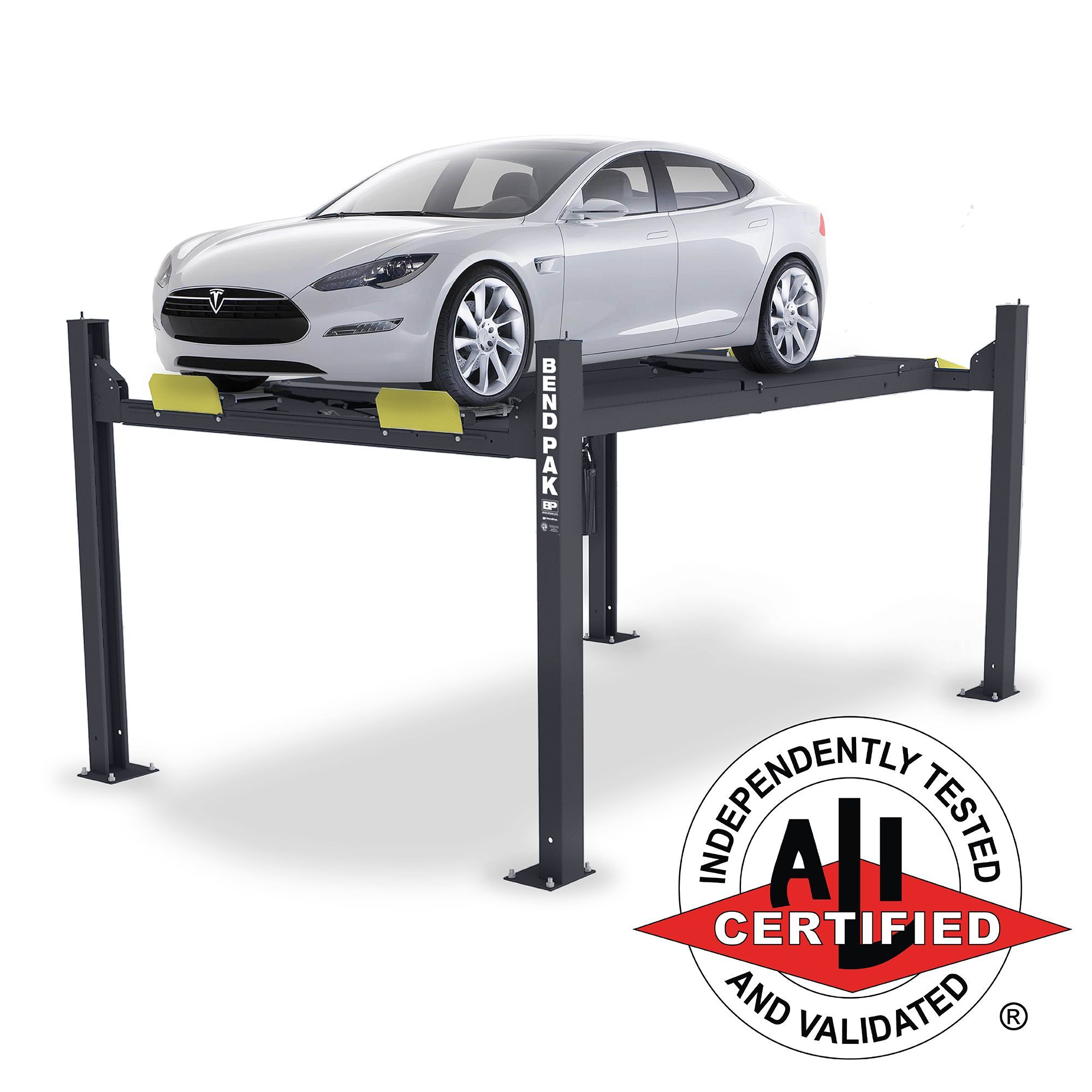
4-Post Lifts: More Forgiving
Four-post lifts spread the load across a much larger area. Instead of two columns with concentrated anchor points, you've got four posts with wide base plates, plus the weight distributed along the runways.
The concrete requirements still apply, but 4-post lifts are generally more forgiving because the force per square inch is lower. Models like the BendPak HD-9AE at $9,395 distribute 9,000 lbs across four points instead of two, cutting the per-anchor stress roughly in half.
If your slab is borderline -- maybe 3.5 inches thick or lower-PSI concrete -- a 4-post lift is the safer bet. Some 4-post models don't even require floor anchoring for basic storage use, though we always recommend anchoring for any service work.
Portable Lifts: The Concrete-Friendly Option
If your garage floor doesn't meet the requirements and you're not ready to pour new concrete, portable lifts are the answer.
QuickJack and MaxJax systems sit on top of the slab rather than anchoring into it. They still need a flat, level concrete surface -- you can't use them on gravel or asphalt -- but the thickness and PSI requirements are far more relaxed.
Check out our QuickJack vs MaxJax comparison to see which portable system fits your situation.
What If Your Concrete Doesn't Pass
You've checked your slab and it's too thin, too weak, or cracked. Now what.
Option 1: Pour a New Pad
The most reliable fix. Cut out the section of floor where the lift posts will sit (typically two 4x4-foot areas for a 2-post lift), excavate the old concrete, and pour new pads to the right spec. This runs $1,500 to $3,000 depending on your area and whether you need rebar.
Some owners pour the entire garage floor fresh if the existing slab is in rough shape. That's $5,000 to $10,000 but gives you a perfect foundation for any lift, now and in the future.
Option 2: Reinforce With Steel Plates
A few installers use steel plates bolted to the floor surface to spread the load over a wider area. This can work on marginally thin slabs, but it's a bandaid, not a fix. Most lift manufacturers don't endorse this method, and if something goes wrong, your warranty claim gets complicated.
Option 3: Switch Lift Types
Going from a 2-post to a 4-post or from a permanent lift to a portable system might solve the problem without any concrete work. A Dannmar D2-10A needs the same concrete specs as a BendPak 2-post, but a 4-post lift or portable system may work on your existing floor.
Planning a New Garage Build
If you're building a new garage or pouring a new slab, specify your concrete with a lift in mind from day one. It's dramatically cheaper to pour the right slab up front than to tear it out and redo it later.
Tell your concrete contractor:
- 6 inches thick minimum across the full slab
- 4,000 PSI concrete mix
- #4 rebar on 18-inch centers, both directions, set on 2-inch chairs
- Smooth trowel finish (not stamped or textured)
- Control joints planned to avoid your intended lift placement
That last point matters. Work with your contractor to locate control joints so they don't land where your lift posts will go. A few inches of adjustment in the joint layout costs nothing during the pour and saves major headaches during installation.
And while you're planning, make sure you've got the electrical requirements covered too. A dedicated 220V circuit for the lift should be part of your garage wiring plan.
The Bottom Line on Concrete
Your garage floor is the foundation -- literally -- of your entire lift installation. Get it right and you'll have a safe, solid platform for decades of use. Get it wrong and you're looking at anchor failures, cracking, and the kind of safety risk that keeps people up at night.
For most homeowners, the BendPak 10AP-168 on a properly specified concrete slab is the setup that turns your garage into a real shop. At $7,545 with 10,000 lbs of capacity, it handles everything from daily drivers to full-size trucks -- as long as what's underneath it can handle the load.
Not sure if your floor is ready? Grab a tape measure, check that slab thickness, and browse our full 2-post lift buying guide to match the right lift to your garage. You can also check our car lift safety guide for the full rundown on safe installation and operation practices.