What Ceiling Height Do I Need for a Car Lift?
Ceiling height is the number one reason home garage owners cannot install the lift they want. We hear it every week: someone falls in love with a BendPak 2-post lift, measures their garage, and discovers they are 2 feet short. Understanding ceiling height requirements before you start shopping saves time, money, and disappointment.
This guide covers the exact ceiling height requirements for every type of vehicle lift, how to measure correctly, and what to do if your garage falls short.
How to Measure Your Ceiling Height
Before looking at any lift specifications, measure your actual ceiling height accurately.
What to Measure
-
Floor to ceiling height: Measure from the concrete floor to the lowest point of the ceiling structure. This might be the bottom of the drywall, the bottom of the joists, or the bottom of any ductwork, piping, or other obstructions.
-
Account for obstructions: Garage door tracks, openers, lighting fixtures, and HVAC ducts all reduce usable ceiling height. Measure to the lowest obstruction in the lift area, not just the ceiling surface.
-
Measure at the lift location: Ceilings are not always level. Measure at the exact spot where you plan to install the lift, not at the garage door or along the walls.
-
Check for slope: Some garage floors slope toward the door for drainage. A 2-inch slope over 20 feet is common. Measure the ceiling height at the back of the garage where the lift will be positioned.
Common Residential Ceiling Heights
| Garage Type | Typical Ceiling Height |
|---|---|
| Standard attached garage (pre-2000) | 8' - 9' |
| Standard attached garage (newer construction) | 9' - 10' |
| Detached garage / shop | 10' - 14' |
| Barn-style garage | 12' - 16'+ |
| RV garage | 14' - 16'+ |
| Commercial shop | 14' - 20'+ |
Ceiling Height Requirements by Lift Type
2-Post Lifts
2-post lifts have the most demanding ceiling requirements because the columns extend well above the vehicle.
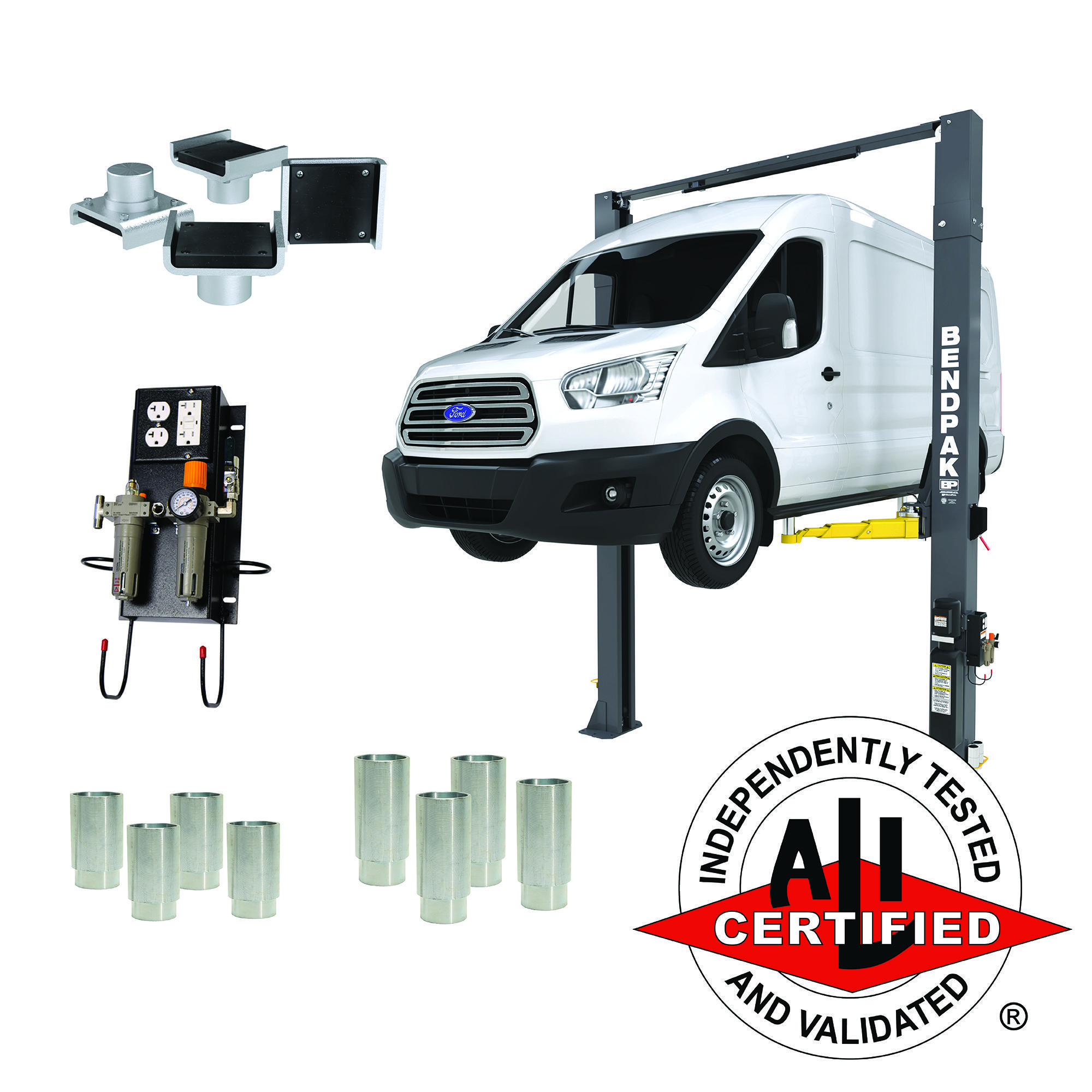
Standard 2-post lift (like the BendPak 10AP-168):
- Overall height: 168 inches (14 feet)
- Minimum ceiling clearance: 14 feet 6 inches (to clear the overhead beam and allow the lift to reach full height)
Extended-height 2-post lift (like the BendPak 10APX-181):
- Overall height: 181 inches (15 feet 1 inch)
- Minimum ceiling clearance: 15 feet 6 inches
Low-profile 2-post lift (models designed for lower ceilings):
- Overall height: 130-140 inches (10'10" - 11'8")
- Minimum ceiling clearance: 11 feet 6 inches
Important note: The minimum ceiling height is not just about fitting the lift. You also need clearance between the top of the raised vehicle and the ceiling. A vehicle on a 2-post lift rises to about 6 feet -- the wheels hang about 4-5 feet off the ground plus the vehicle height of 4.5-6 feet. With lower ceilings, the lift may not reach full rise, reducing your working space underneath.
4-Post Lifts
4-post lifts have similar ceiling requirements to 2-post lifts because the columns are the same height.
Standard 4-post lift (like the BendPak HD-7PXW):
- Overall height: 82-90 inches at full rise (shorter than 2-post because the column extends above the platform)
- Vehicle on lift: Add 55-75 inches for vehicle height on top of the platform
- Minimum ceiling clearance: 11 feet for most passenger vehicles, 12 feet for trucks and SUVs
Portable Frame Lifts (QuickJack)
QuickJack lifts have virtually no ceiling height restrictions because the vehicle only rises about 21 inches.
QuickJack models (like the 7000TL or 3500SLX):
- Vehicle rise: approximately 21 inches
- Minimum ceiling clearance: Vehicle height + 21 inches + a few inches of comfort margin
- Works in any standard garage with 8-foot or higher ceilings
Portable 2-Post Lifts (MaxJax)
MaxJax lifts need more clearance than QuickJack but less than full-size 2-post lifts.
MaxJax M7K (110V model):
- Overall column height: approximately 100-110 inches
- Vehicle at full rise: approximately 69 inches of rise
- Minimum ceiling clearance: 11 feet recommended
Low-Rise Scissor Lifts
Scissor lifts like the Dannmar DLR-6 raise the vehicle 3-4 feet:
- Vehicle rise: 36-48 inches
- Minimum ceiling clearance: Vehicle height + rise + 6 inches
- Works in most garages with 9-foot or higher ceilings
Parking Lifts
Parking lifts that stack two vehicles vertically need the most ceiling clearance.
Standard parking lifts (like the Autostacker A6S):
- Need total clearance for two stacked vehicles plus the lift structure
- Minimum ceiling clearance: 12-14 feet depending on vehicle heights
Lift Options by Ceiling Height
Here is a quick reference for what you can install at each ceiling height:
8-Foot Ceiling (Standard Garage)
- QuickJack 3500SLX -- $1,775
- QuickJack 7000TL -- $1,850
- QuickJack 8000TLX -- $2,375
- Low-rise scissor lifts
9-10 Foot Ceiling
All of the above, plus:
- Low-rise scissor lifts at full rise
- Mid-rise lifts (limited models)
11-12 Foot Ceiling
All of the above, plus:
- MaxJax M7K -- $5,195
- Select low-profile 2-post lifts
- Most 4-post lifts for passenger vehicles
12-14 Foot Ceiling
All of the above, plus:
- BendPak 10AP-168 -- $7,545
- Most 2-post lifts
- 4-post lifts for trucks and SUVs
- Some parking lifts
14+ Foot Ceiling
All lifts are viable, including:
- BendPak 10APX-181 -- $8,445
- BendPak HDS-14LSXE -- $13,095
- Extended-height 2-post lifts
- Full-height parking lifts
Solutions for Low Ceilings
If your ceiling is too low for the lift you want, you have several options.
Option 1: Choose a Different Lift Type
The simplest solution. If your ceiling is 8-9 feet, a QuickJack portable lift gives you real lifting capability with zero ceiling concerns. The QuickJack 7000TL at $1,850 handles most vehicles and works in any garage.
Option 2: Raise the Roof
If you own the property and the garage is detached, raising the roof is an option. This is a significant construction project ($10,000-$30,000+) but gives you the ceiling height for any lift. Many serious car enthusiasts build dedicated shop buildings with 14-16 foot ceilings specifically for this purpose.
Option 3: Lower the Floor
Excavating the garage floor to gain ceiling height is technically possible but expensive and disruptive ($15,000-$40,000). It is only practical in specific situations, such as garages built on a raised slab.
Option 4: Create a Pit
A below-grade maintenance pit gives you undercar access without any ceiling height requirement. Pits are common in European garages but rare in the US due to code restrictions, water table concerns, and safety issues. Check local building codes before considering this option.
Option 5: Work Outside
Some homeowners install a permanent lift on a concrete pad outside the garage, either under a carport or in the open. This eliminates ceiling restrictions entirely but introduces weather considerations. Many QuickJack owners already use their lifts in driveways and open garage bays.
Frequently Asked Questions
Can I install a lift if the ceiling height is exactly at the minimum?
Technically yes, but we recommend at least 6 inches of buffer above the lift's maximum height. This prevents the lift, vehicle, or any tooling from contacting the ceiling and gives the lift room to reach full rise.
Does the garage door height matter?
Not for the lift itself, but it matters for getting vehicles in and out. If your garage door opening is 7 feet and your vehicle is 6.5 feet, the lift columns on either side of the door could interfere with entry if positioned too close to the opening. Plan your lift placement to avoid conflicts with the door track and opening.
Can I install a lift without an overhead beam?
Some 2-post lifts, like the BendPak SP-7XEF at $10,295, use a floor-plate design instead of an overhead beam connecting the two columns. This eliminates the overhead obstruction but the columns still have the same height requirements.
What if my ceiling is uneven?
Many residential garages have angled ceilings that follow the roof pitch. Measure at the lowest point in the lift area. If the ceiling angles upward, you may be able to position the lift where the ceiling is highest, but the columns must be level regardless of ceiling angle.
Do I need to account for overhead lighting?
Yes. If you have fluorescent fixtures, pendant lights, or other hanging fixtures in the lift area, either relocate them or factor their height into your clearance calculation. Many lift installations include upgrading to flush-mount LED panels to maximize usable ceiling height.
Plan Your Lift Installation
Not sure which lift fits your garage? Use our Dream Garage Builder to enter your exact garage dimensions and see which lifts fit. The 3D visualization makes ceiling clearance immediately obvious.
Browse our complete selection of lifts by type:
For more detailed guidance, read our Best Car Lifts for Your Home Garage guide or our 2-Post Lift Buyer's Guide.