Car Lift Electrical Requirements for Your Home Garage
Most people spend weeks researching which car lift to buy. They compare weight capacities, measure ceiling heights, even check their concrete thickness. Then the lift shows up and they realize they don't have the right electrical setup to power it.
Don't be that person.
Your garage's electrical system is one of the first things you should evaluate -- before you order anything. The good news is that wiring a garage for a lift isn't complicated or wildly expensive. But you need to know what you're dealing with, and you need to plan ahead.
110V vs. 220V -- What Most Home Lifts Actually Need
Here's the breakdown. Two-post lifts with capacities above 9,000 lbs almost always require 220V (also called 240V) single-phase power. These are the big boys -- the BendPak XPR-10 series, commercial-grade units, and heavy-duty alignment lifts.
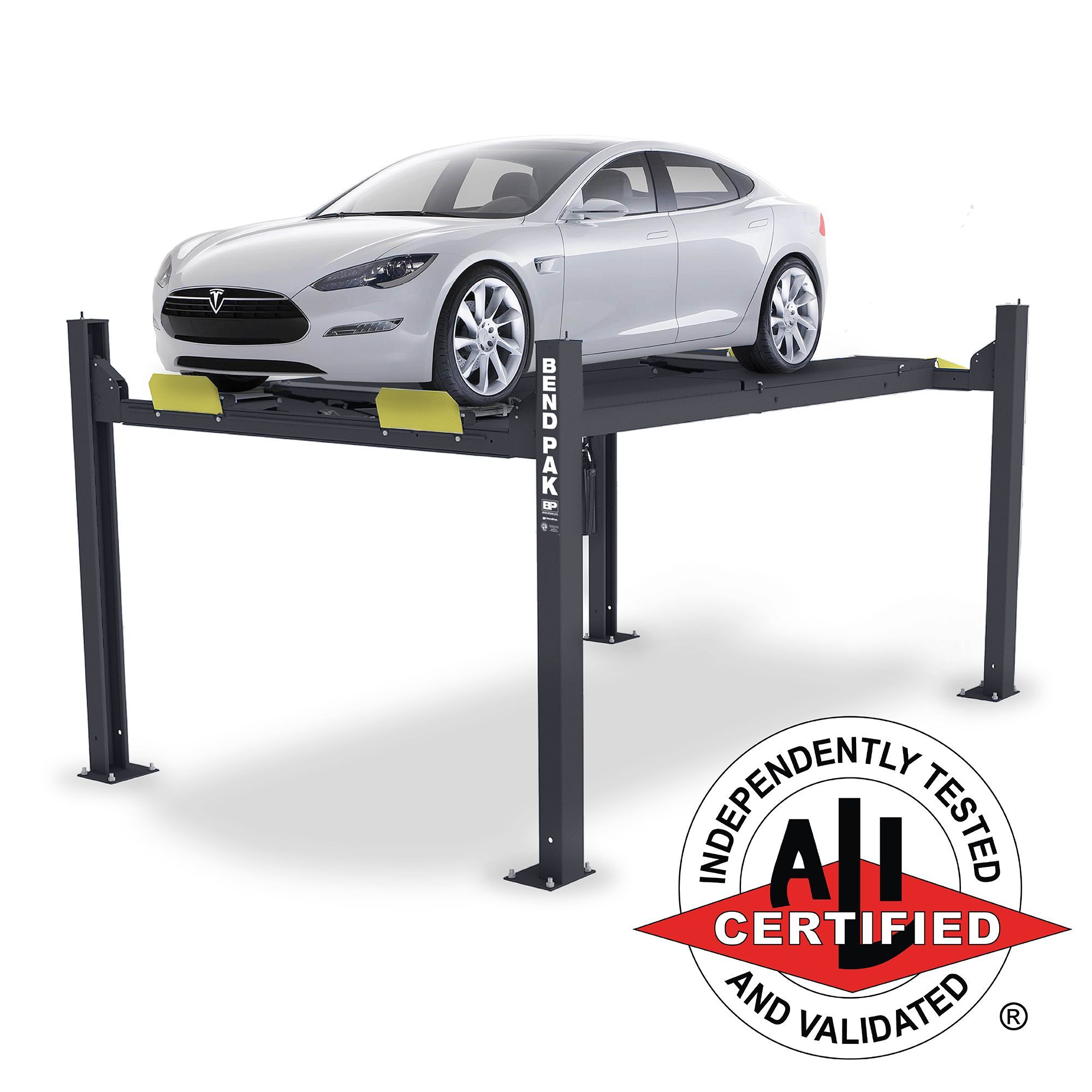
But a huge number of home-friendly lifts run perfectly fine on standard 110V household power. Four-post storage lifts, low-rise scissor lifts, portable lifts like the QuickJack -- most of these plug into a regular outlet.
The catch is that "regular outlet" doesn't mean the same outlet your garage door opener and shop vac share. You need a dedicated circuit. More on that in a minute.
220V: What You're Actually Getting Into
If your lift requires 220V, here's what the install looks like:
You'll need a licensed electrician to run a new circuit from your main electrical panel to the lift's power unit location. That means a 30-amp double-pole breaker, 10-gauge wire (typically 10/2 NM-B or THHN in conduit depending on your local code), and a 220V receptacle near the lift.
Cost for most garages runs $300 to $800 depending on how far the panel is from the lift location. If your panel is on the opposite side of the house and you need to trench conduit through the attic or crawlspace, budget closer to $1,000-$1,500.
The specs that matter:
- Breaker: 30-amp, double-pole (240V)
- Wire gauge: 10 AWG minimum for runs under 50 feet
- Wire gauge for longer runs: 8 AWG for runs over 50 feet to prevent voltage drop
- Receptacle: NEMA 6-30R (the standard 220V/30A outlet)
- Circuit: Dedicated -- nothing else on it
That last point is critical. Your lift motor draws a heavy surge when it starts. If it's sharing a circuit with your air compressor or welder, you're going to trip breakers constantly. And tripping a breaker while a 4,000-lb truck is halfway up is not a fun afternoon.
110V: Simpler Than You Think
A 110V lift plugs into a standard household outlet. But again -- dedicated circuit. That means a 20-amp single-pole breaker with 12-gauge wire running to one outlet that powers nothing but the lift.
Most garages already have 20-amp circuits. The question is whether any of them are dedicated. If your garage has two outlets on the same circuit (common in older homes), and one of them runs your refrigerator while the other powers the lift, you're asking for problems.
A dedicated 20-amp 110V circuit costs $150 to $400 to install. That's it. And it opens up a whole category of lifts that a lot of people don't even consider.
The specs:
- Breaker: 20-amp, single-pole (120V)
- Wire gauge: 12 AWG
- Receptacle: Standard NEMA 5-20R
- Circuit: Dedicated
Lift speed on 110V is slightly slower than 220V -- we're talking maybe 30-45 seconds to full rise instead of 20-25. For a home garage where you're lifting your car once or twice a week, that difference is meaningless.
How to Check What Your Garage Has Right Now
Before you call an electrician, do a quick audit. Open your main electrical panel and look for the breakers labeled "garage." Count how many there are, note their amperage, and check if any are double-pole (220V).
Most residential garages come wired with one or two 15-amp or 20-amp 110V circuits. That's enough for lights, a garage door opener, and a couple outlets. It's not enough for a car lift sharing those circuits.
If you see a 30-amp or 40-amp 220V breaker already in the panel, you might be in luck -- some garages are pre-wired for a dryer, EV charger, or workshop equipment. Check where that circuit terminates and you might already have the power you need.
Three things to verify:
- Panel capacity -- Does your main panel have open slots for new breakers? If it's fully loaded, you may need a sub-panel in the garage ($500-$1,000 installed).
- Circuit availability -- Can you dedicate an existing 20-amp circuit, or do you need a new one?
- Distance -- How far is the panel from where the lift will sit? Longer runs need thicker wire.
Skip the Extension Cord
This deserves its own section because people try it constantly.
Never run a car lift off an extension cord. Not a heavy-duty one, not a 10-gauge one, not even a short one. Extension cords cause voltage drop, overheat under sustained load, and void your lift's warranty. Every lift manufacturer says the same thing: plug directly into a wall outlet on a dedicated circuit.
If the outlet isn't close enough to the lift's power unit, have an electrician install one where you need it. A new outlet costs $100-$200. That's cheaper than burning out a $500 power unit.
The 110V Portable Lift Option Most People Miss
Here's where things get interesting for a lot of home garage owners.
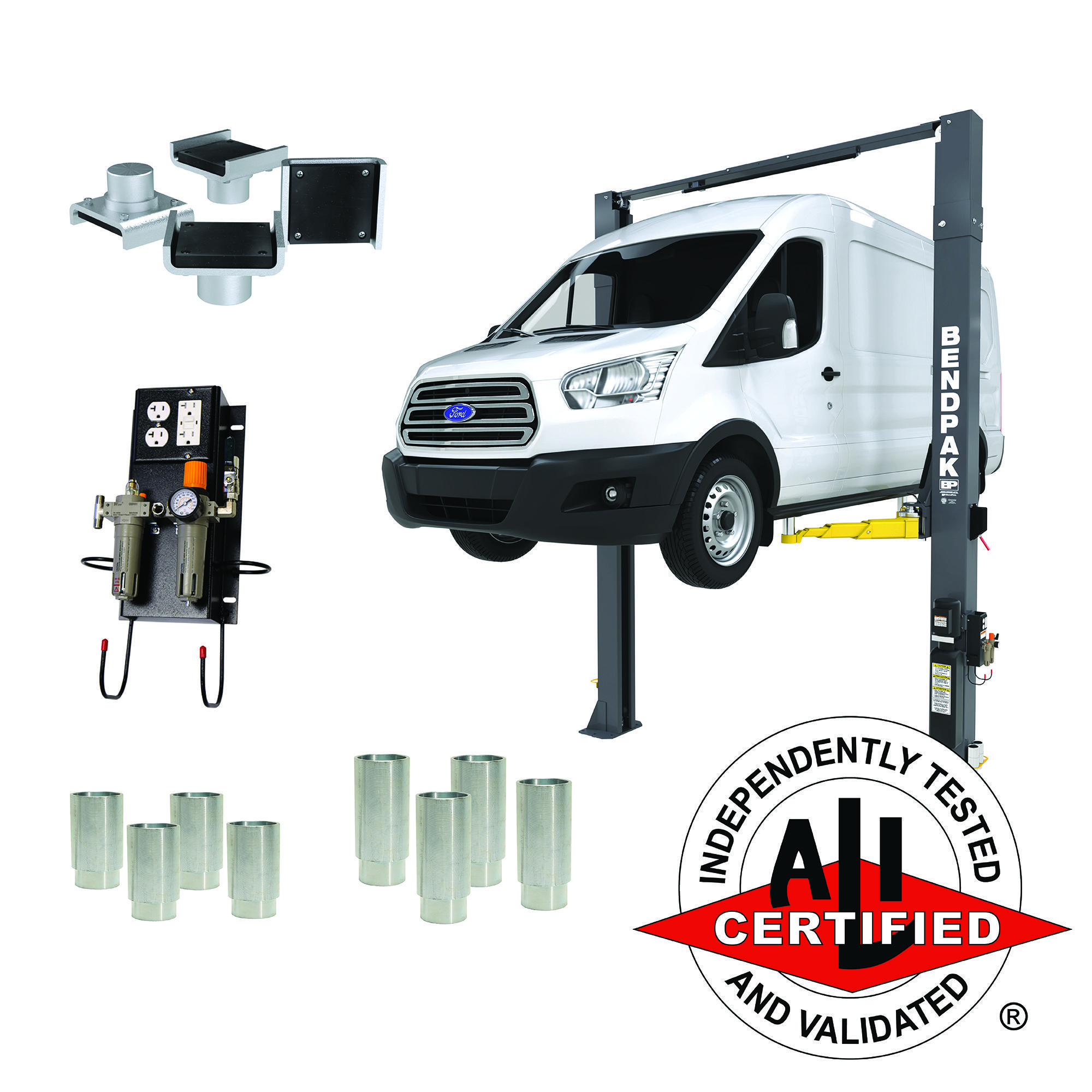
If your garage doesn't have 220V and you don't want to spend $500-$1,500 on electrical work, there's a category of lifts designed specifically for you. The MaxJax M7K is a portable two-post lift that runs on standard 110V power and lifts up to 7,000 lbs.
That's enough capacity for full-size sedans, SUVs, and light-duty pickups.
The M7K plugs into a dedicated 20-amp 110V outlet -- the same circuit we talked about above, the one that costs $150-$400 to install. No 220V, no double-pole breaker, no 10-gauge wire runs across the garage. Just a standard outlet on its own circuit.
And the MaxJax does something no permanent two-post lift can do: it stores flat against the wall when you're not using it. You get full two-post lift access -- wheels-off capability, 47.5 inches of lift height, seven lock positions -- and then you fold it away and park your car in the same spot.
At $5,695 for the Ultimate Package (SKU: 5175572), it ships free nationwide and comes with the power unit, arms, and all mounting hardware. Each column anchors with five bolts rated to 16,500 lbs apiece. So the "but is it safe" question has a straightforward answer: 82,500 lbs of holding force per column.
For a home mechanic whose biggest electrical obstacle is not having 220V in the garage, the M7K is the lift that makes the whole project possible without rewiring anything beyond a single dedicated outlet.
What to Tell Your Electrician
When you call for a quote, give them these details upfront:
- The lift model and its voltage/amperage requirements (check the manual or spec sheet)
- Where in the garage the lift's power unit will be located
- The approximate distance from your main panel to that location
- Whether you need 110V or 220V service
Most electricians can knock this out in half a day. If you're getting 220V run to the garage, ask them to add a couple extra 20-amp 110V circuits while they're at it. You'll want them for an air compressor, charger, or shop lights down the road. Adding circuits during the same visit is way cheaper than calling them back later.
And get a permit if your jurisdiction requires one. Car lift electrical work is straightforward, but it still needs to meet code. A good electrician handles the permit for you.
Match the Lift to Your Electrical Reality
The worst approach is buying a lift first and then figuring out the electrical. Start from the other direction.
Check your panel. Figure out what you have and what it would cost to upgrade. Then pick the lift that fits your garage -- both the physical space and the electrical capacity.
If you've got 220V or can add it cheaply, the full range of two-post lifts and four-post lifts opens up. If you're working with 110V and want to keep things simple, a portable option like the MaxJax M7K gives you real lifting capability without the electrical headache.
Either way, budget the electrical work into your total project cost from day one. A $4,000 lift plus $600 in wiring is still a fraction of what you'd pay a shop for a year's worth of labor. And once it's done, it's done -- you've got a lift-ready garage for the rest of the time you live there.
Browse our full car lift collection or check the ceiling height guide and car lift safety guide to make sure the rest of your garage is ready too.