How to Cool a Large Garage: The Industrial Setup That Beats Window ACs
A 3-car garage is roughly three times the volume of your bedroom. Stack a 12-foot ceiling on it and you're looking at a space that holds 10,000 cubic feet of air. Now try cooling that with a $400 window AC rated for 600 square feet, and you'll spend the rest of the summer standing in front of a fan, sweating onto your fender covers.
This is the problem nobody talks about when they sell you the lift and the flooring. The cooling spec is missing.
Big garages defeat consumer cooling gear. The math just doesn't work.
Why a Large Garage Is a Different Problem
A standard bedroom is 12 by 12 with an 8-foot ceiling. That is about 1,150 cubic feet of air. A 3-car garage with a 12-foot ceiling can run from 7,500 to over 12,000 cubic feet. Add a workshop bay or a detached shop and you are pushing 15,000-plus.
That volume matters more than square footage because heat fills the entire vertical column. Hot air rises, stratifies near the ceiling, and radiates back down all night. A small unit sized off square footage will run nonstop and still lose ground.
Window ACs max out around 15,000 BTU. That covers maybe 700 square feet of insulated living space. Drop that same unit in a 1,000-square-foot uninsulated shop with a 12-foot ceiling and a metal door radiating heat, and it'll short-cycle, ice up, or just give up entirely.
Portable AC units are worse. They vent hot air through a hose that has to go somewhere, they pull air from the room they're trying to cool, and they top out around 12,000 BTU. Save your money.
The Three Cooling Paths for a Big Garage
You have three real options, and they cost very different amounts.
Central AC tied into your house. Run new ductwork into the garage, add a zone damper, upgrade the condenser if it can't handle the extra load. Expect $8,000 to $15,000 installed. You'll also need to insulate the garage to R-30 in the ceiling, or you'll be cooling the outdoors. This is the most comfortable solution. It's also the most expensive and the slowest to install.
Ductless mini-splits. A 24,000 BTU mini-split runs around $2,500 to $4,500 installed and covers maybe 1,000 square feet of a properly insulated garage. A 36,000 BTU unit gets you closer to 1,400 square feet. For a 3-car shop you're looking at two zones, two condensers, and somewhere between $6,000 and $10,000 total. Same insulation requirements as central air.
Industrial evaporative cooling. A single unit handles 4,000 to 6,000 square feet and installs the same day you unbox it. No ductwork. No refrigerant. No permit. Just a 240V outlet, a water hookup, and a few hours to set the pads and fill the tank. Cost is roughly $3,000 to $4,500 for a unit that'll cover a full shop.
For most home shops in dry climates, the third path wins on cost, install time, and operating expense. The catch is climate.
When Evaporative Cooling Is the Right Call
Evaporative coolers work by pulling hot dry air through wet pads. Water evaporates, pulls heat out of the air, and dumps cooled air into the room. The drier the incoming air, the bigger the temperature drop.
In Phoenix in July, outside air at 105 degrees and 15 percent humidity can come out of an evap cooler at 75 degrees. That is a 30-degree drop. In Las Vegas, Albuquerque, Denver, Salt Lake City, El Paso, Reno, Boise, Spokane, or anywhere east of the Cascades in Washington and Oregon, evap cooling is the right tool.
Below 50 percent humidity, evap cooling pulls real numbers. Below 30 percent it is brutally effective.
Above 60 percent humidity it falls apart. The air cannot hold any more moisture, so the evaporation slows down, and you end up just blowing damp air at yourself. If you are on the Gulf Coast, the Southeast, or anywhere east of the Mississippi during peak summer, look at mini-splits instead.
So before you buy anything, pull up your local climate data and check the average July humidity. If it stays under 50 percent through summer, evap cooling will run circles around AC at a fraction of the cost.
The Cool Boss CB-28HV Desert Storm: Built for This Job

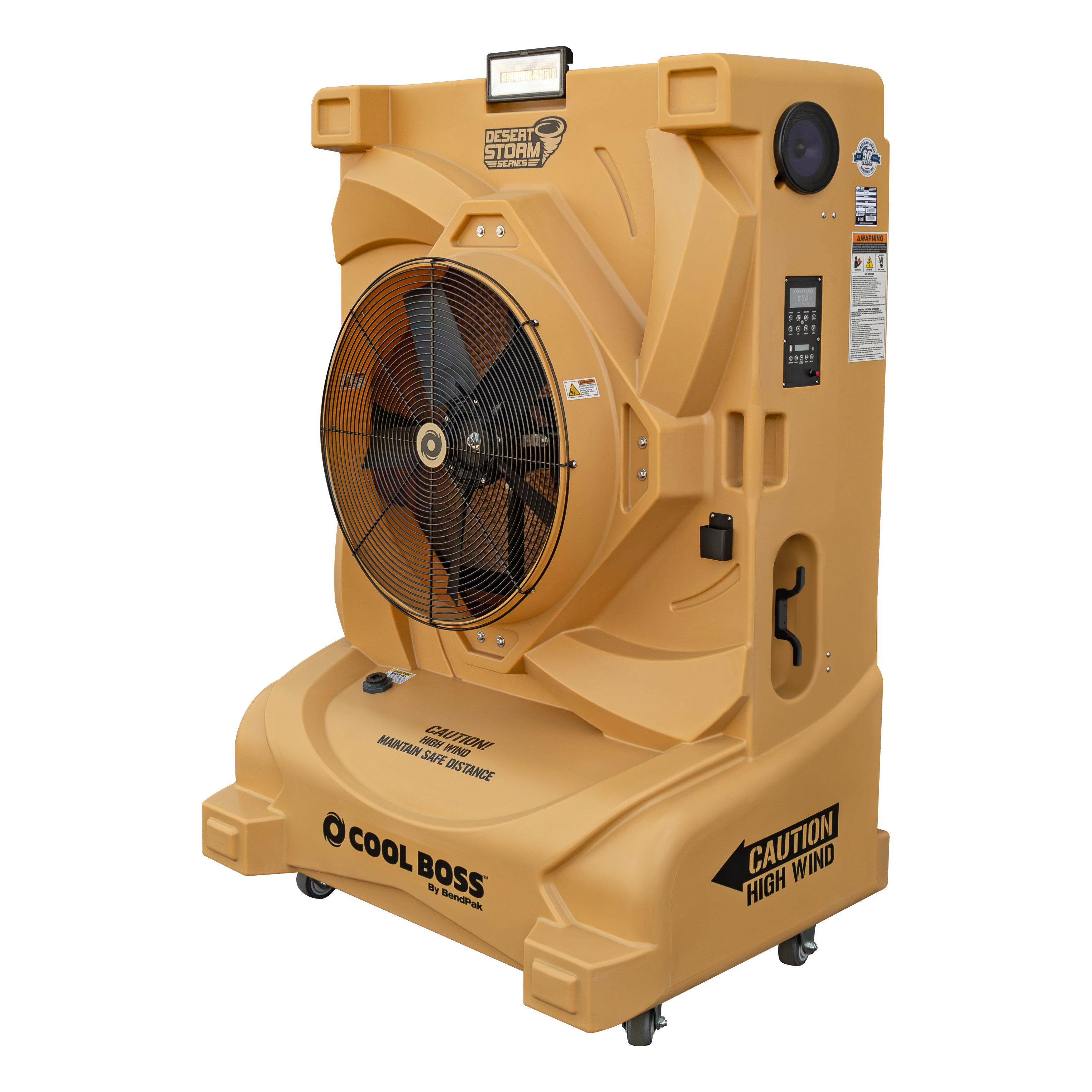
The Cool Boss CB-28HV Desert Storm is the unit I point people at when they have a real shop to cool. It is built by Cool Boss, a BendPak subsidiary out of Santa Paula, California, and it is the largest portable evap cooler in the lineup short of going into permanent commercial install territory.
The specs are the kind of numbers that put the problem to bed:
- 12,180 CFM through a 28-inch axial-flow fan with a 5-blade rotor
- 6,090 square feet of cooling coverage
- 80-gallon water tank -- enough for 45-plus hours of runtime between fills
- 1.75 gallons per hour water consumption
- 2.5 HP motor with 10 fan speeds from 1,450 to 2,175 RPM
- 208-240V, 16.94 amp draw, GFCI plug, UL certified
- 76 inches tall, 53 wide, 37 deep, on four 4-inch swivel casters
- 292 pounds empty, 958 pounds with a full tank
- 75 dB at full tilt, which is loud but not louder than a shop fan
That is industrial-grade kit. The fan alone moves more than four times the air of a 36-inch drum fan, and it is dropping the temperature 15 to 25 degrees on the way through.
Two bonus features that matter more than they look on paper. The unit has a built-in 4,000-lumen LED floodlight mounted high on the housing, which is enough light to flood a bay. And it has a Bluetooth audio system with a USB port. Sounds silly until you realize you just replaced a shop light tower and a portable speaker with one machine. That is real money back.
Price runs $3,795 with free nationwide shipping. List is $4,095, so you are getting $300 off right now.
Against a mini-split install, you save the labor, the line set, and the wall penetration. Against a central AC tie-in, you save the duct work and the insulation upgrade you would otherwise be forced into on day one.
How to Set It Up Right
Evap coolers do not work like air conditioners. There are three rules that separate a setup that drops 25 degrees from one that just blows damp air.
Cross-ventilate, always. An evap cooler needs a path for the cooled, humidified air to exit the space. If you close the garage door tight, the humidity climbs, evaporation slows, and the temperature drop drops with it. Park the cooler near one door or vent and crack a window or the man door on the opposite wall. The cooled air should sweep across the bay and exit.
Pre-cool before you start work. Fire the unit up at 9 or 10 in the morning, run it on speed 6 or 7 for an hour before you touch a tool. You are pulling heat out of the concrete slab and the walls, which is where most of the load comes from. By the time you start working, the room is sitting 20 degrees below ambient instead of trying to catch up.
Aim the airflow where you are. A 28-inch fan throws air a long way. Park the cooler at one end of the bay, point it at the lift or the workbench, and let it sweep. Do not point it at a wall and hope.
The 10-speed control matters here. On a 95-degree dry day, speed 4 or 5 is usually plenty. Save speed 10 for the days that hit 110.
What This Does Not Replace
Insulation. Read that again. Insulation.
An uninsulated garage with a metal door is a heat sink. The CB-28HV will still cool it, but you are working against a 130-degree slab that has been baking since sunrise. R-13 in the walls, R-30 in the ceiling, and an insulation kit on the door triples the value of any cooling solution you bolt on. Spend $1,500 on insulation before you spend $3,795 on cooling. The order matters.
The unit also does not dehumidify. It adds moisture to the air on purpose, which is the whole point. If you are in a climate where humidity is the enemy, this is not your machine.
And it does not heat. For winter, you need a separate plan -- which for most large garages means a propane forced-air heater or a 240V electric unit heater.
Where This Fits in the Bigger Plan
If you are running a 3-car garage or a detached shop, cooling is just one of the five systems you eventually have to deal with: floor, lift, storage, lighting, and climate. Most people sort them in that order because the floor and the lift are the visible upgrades.
Climate gets ignored until July, when the floor is finished, the lift is bolted down, and the garage is too hot to use. That is when the call comes in.
If you are mapping out a full build, walk through the Dream Garage Builder and plan the bay layout first. Then read How to Build the Ultimate Home Mechanic Shop for the order of operations. Then size your cooling to match the volume of the finished space, not the empty shell you started with.
The CB-28HV is the cooling answer for any dry-climate home shop bigger than two cars. Smaller spaces, the CB-16L from our summer cooling guide handles up to about 1,400 square feet for under $3,000. Pick the one that fits your volume.
Either way, your garage should be a place you actually want to spend the afternoon in. Even when it is 105 outside.
Browse the full Cool Boss lineup or start shopping for your CB-28HV here. Free shipping, authorized dealer, in stock and ready to ship.