Tire Changer for Home Garage: What It Really Takes
Four sets of wheels in one garage isn't unusual anymore. Summer, winter, track, and the set that's been listed on Marketplace for two years. Twice a year those wheels get loaded into a truck bed, driven across town, and left in a lobby for ninety minutes, and about one time in five something comes back with a fresh scar down a rear barrel.
That routine has an expiration date.
Most people hit it somewhere around the fourth season, usually right after a shop hands back a wheel they'd just had refinished.
Start with the honest math, because it probably doesn't work
I'm going to talk you out of this before I talk you into it.
A professional tire changer and a wheel balancer together run about $7,300. Mount and balance at a shop is somewhere in the $25 to $50 a corner range depending on where you are and what you're running, and a straight seasonal swap on wheels you already own costs less than that. Call it $150 to $250 a year for a guy with one car and two sets.
That's a thirty-year payback. Nobody buys equipment on those numbers.
So if you've got one daily driver and a set of snows on steelies, close this tab and keep driving to the shop twice a year. You're doing the right thing.
But that's not who ends up owning these machines.
Who it actually makes sense for
The people who put a changer in their own garage tend to look the same on paper. Four or five vehicles between the family. A trailer with its own set. Maybe a track car that goes through a set of Rivals a season and needs them swapped between Friday night and Saturday morning, which is a window no shop is open for.
Or they own wheels they don't want anyone else touching. Forged three-piece barrels, powder-coated lips, a set of period-correct BBS on a restored car that runs four figures to refinish if somebody drops a mount head on them.
Then there's timing, which is the one nobody predicts. Tires arrive on a Tuesday. The shop can see you Saturday. With a machine on your own floor they go on Tuesday night.
That's the real product here. Not savings -- control, and the calendar.
The machine most home shops should buy is the R76LT
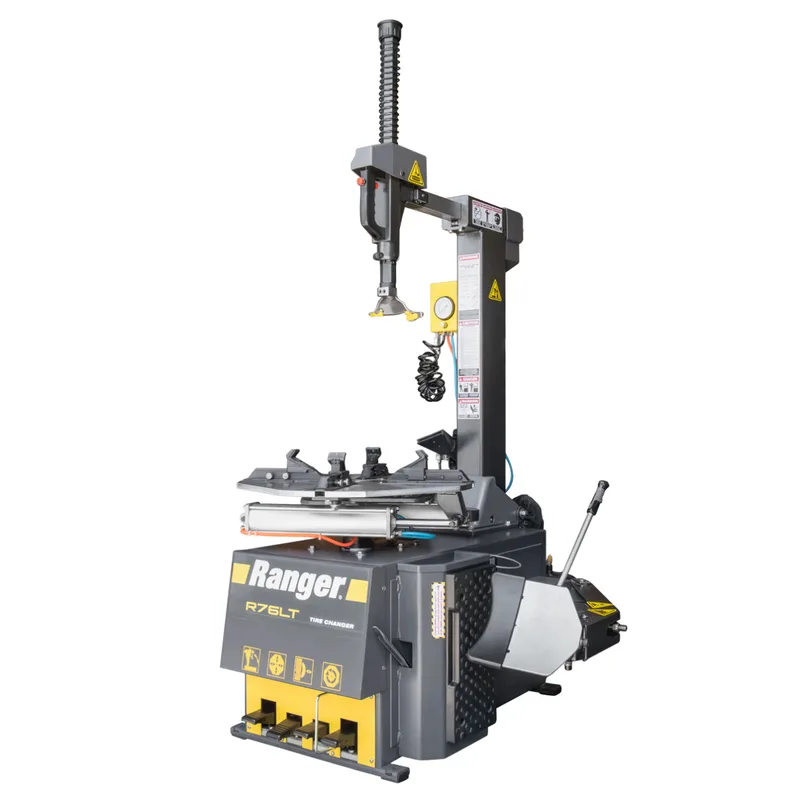
Ranger builds a full ladder of tire changers and it's easy to overbuy. The Ranger R76LT at $3,995 is the one I'd put in a serious home garage.
It uses a tilt-back tower, and that matters more than the spec sheet makes it sound. On a swing-arm machine you readjust the duck head for every wheel diameter you load, which is tolerable for one car and genuinely maddening when you're working through sixteen wheels on a Saturday afternoon. A tilt-back tower drops back to the same position for a matched set. Load, clamp, tilt, go.
The turntable clamps 30 inches internally and 26 inches externally. That covers everything a home shop will ever see and most of what a real shop sees. The vertical shaft is a 45 mm hex, and the bead breaker runs a stainless steel cylinder body, so the moisture that lives in every home air line isn't quietly rusting it from the inside out.
It also runs an electric turntable, and the rotation is deliberately unhurried rather than quick. That's a low-profile feature. A bead that gets yanked snaps. A bead that gets a second relaxes into the drop center and comes off in one piece.
What the R76LT skips is the power-assist arm. Ranger puts that on the R76ATR at $6,995, and if you're mounting run-flats or 30-series rubber on any kind of regular basis, pay the difference and don't look back. For everyone else that assist tower is three thousand dollars of machine you'll use twice. If floor space is the binding constraint rather than budget, the swing-arm R980XR at $4,795 sits closer to a wall than either tilt-back will.
The balancer isn't optional, and that catches people out
This is where budgets come apart. People price a changer, get excited, and forget that a freshly mounted tire is a useless tire until it's balanced.
The Ranger DST2420 runs $3,295 and takes wheels up to 30 inches on a 40 mm shaft. Six-second cycle. It reads to hundredths of an ounce and handles dynamic, static, and the ALU modes you need when the weights have to hide behind spokes instead of clipping onto a lip that isn't there.
The collet package covers 1.75 to 4.25 inches across three cones, plus a 4.50 to 5.00 truck collet in the box. Balancing a lot of trucks and SUVs, add the Truck Cone Kit, part 5150032.
It ships with weights, too. A hundred silver tape weights, a hundred black, and a mixed box of clip-ons. Small thing. But it's the difference between balancing a set the night it lands on your porch and waiting a week on a weight order.
The three things people forget
Air. A tire changer is a pneumatic machine, and the bead breaker and bead seating system both want real volume, not a pancake compressor gasping in the corner. If your compressor already struggles to keep up with an impact gun, it will not run a tire machine. Sort out air before you sort out anything else.
Power and floor space. Confirm the electrical spec for the exact model and configuration you're ordering before it ships, the same way you would for a lift. Our electrical requirements guide walks through how a dedicated circuit in a home garage should be planned. And both machines need a clear working radius, not just a footprint. You walk all the way around a changer.
Floor. These get bolted down and then absorb real shock every time the bead breaker fires. Bare concrete is fine. If you're running modular tile, lay the floor so the machine sits on slab and the tile comes up to meet it rather than running underneath.
Where it goes
Wheel service equipment belongs near the door, not in the back corner. You carry loose wheels to it, and you carry them one at a time.
Keep the changer and the balancer within a few steps of each other along one wall, with the tilt-back tower's swing clear of everything. Leave the middle of the garage for the lift. If you're planning this from scratch, the Dream Garage Builder lets you push the boxes around before anything is bolted down, and the garage workshop layout post covers the traffic logic behind it.
Most people who buy a changer already have a lift. It's the same instinct showing up twice, and if that part is still unsettled, start with the home garage lift guide.
What actually changes
The Saturday disappears.
The swap moves to a Wednesday night after dinner, in your own garage, and it takes a bit over an hour once you've done it twice. Nobody pried on your barrels with a steel bar. The winter set goes up on the rack the same night, still clean, and you never sat in a lobby.
That's the version of this hobby people are actually chasing. Not the savings. The part where the garage does the work instead of the parking lot.
Ranger is a BendPak brand, built by a company that's been making lift and wheel service equipment in Santa Paula, California since 1965. We're an authorized dealer, the wheel service lineup ships free to the 48 contiguous states, and the full Ranger range runs from a basic swing-arm changer up to heavy-duty truck machines if the R76LT turns out to be the wrong rung on the ladder.