Best Air Compressor for a Home Garage Shop
Most home garages have the wrong compressor. It's usually a red 6-gallon pancake that lives under the workbench, screams like a jet engine every 40 seconds, and runs out of breath halfway through a single lug nut. It's fine for topping off tires. It was never built to run a shop.
The good news is that fixing it is simple once you stop shopping by tank size. The number that matters is printed in smaller type on the spec sheet, and almost nobody looks at it.
CFM is the number that matters
Gallons tell you how much air is stored. CFM (cubic feet per minute) tells you how fast the pump can make more. A big tank on a weak pump just means you wait longer for it to refill.
Every air tool has a CFM appetite, usually rated at 90 PSI. Here's roughly what common garage tools pull:
- 1/2" impact wrench: 4 to 5 CFM, in bursts
- Air ratchet: 3 to 4 CFM
- Die grinder or cut-off wheel: 4 to 6 CFM, running steady
- Dual-action sander: 8 to 12 CFM, running steady
- HVLP paint gun: 10 to 14 CFM, running steady
- Media blast cabinet: 10 CFM and up, the whole time the trigger is down
Look at the words "running steady." Impact guns are easy because they work in short bursts and the tank covers the gap. Sanders, grinders, paint guns and blasters are the tools that expose a small compressor. They pull air continuously, and the pump has to keep up in real time.
So size the compressor to your hungriest continuous tool, then add about 30 percent of headroom. If you ever plan to sand a fender or spray a panel, you want 14 CFM or more at 90 PSI. A typical pancake makes around 2.
Single-stage vs. two-stage
A single-stage pump compresses air in one stroke and usually tops out around 135 PSI. A two-stage pump compresses it once in a large cylinder, then again in a smaller one, and pushes to 175 PSI.
Higher pressure means more usable air stored in the same tank. An 80-gallon tank at 175 PSI holds a lot more working air than the same tank at 135. That's why two-stage units feel like they never run out.
Two-stage pumps also tend to run slower and cooler. Slower RPM means less noise, less heat, less water in your lines, and a pump that lasts decades instead of a handful of years. For a garage you plan to spend real time in, this is the way to go.
The compressor we'd put in our own garage
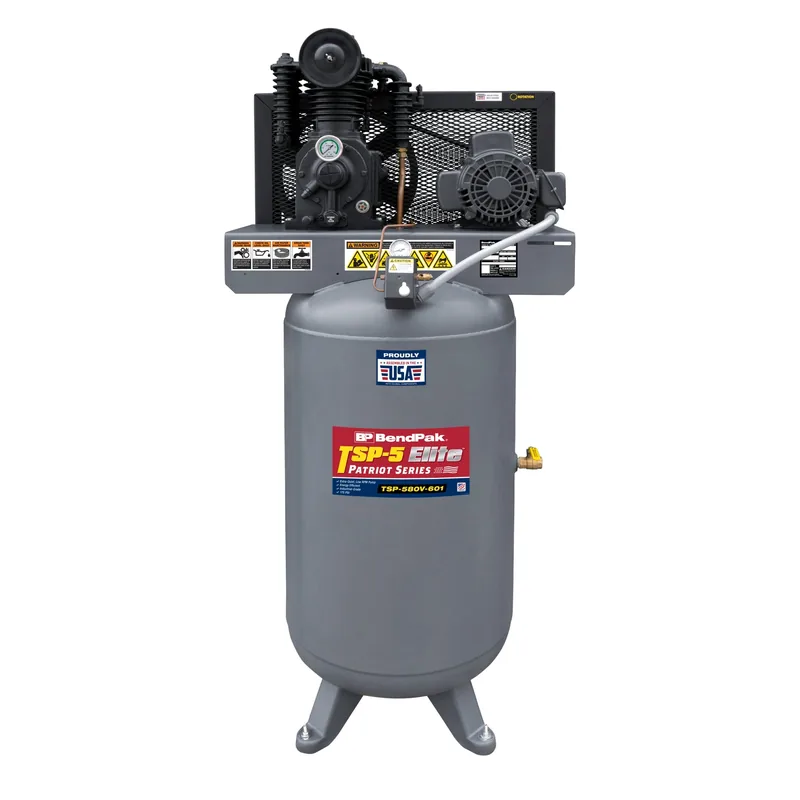
The BendPak TSP-580V-601 is the one. It's a 5 HP, two-stage, splash-lubricated compressor on an 80-gallon vertical tank, built in the USA as part of BendPak's Patriot line, and it sells for $4,395.
The numbers that matter:
- 17.9 CFM at 90 PSI, 17 CFM at 175 PSI
- 175 PSI max pressure
- Continuous duty cycle
- 1,750 RPM pump speed
- 72 dBA sound level
- 24" wide x 34" deep x 72" tall
- 208-230V, single-phase power
- 676 lbs shipping weight
That 17.9 CFM covers everything on the list above with room to spare. You can run a DA sander for an hour straight. You can blast a set of control arms without stopping to let the tank catch up. And because it's rated for continuous duty, it doesn't care how long the job takes.
The 72 dBA figure is the other reason we like it. That's about the level of a vacuum cleaner. A cheap oil-free compressor runs in the high 80s to 90s, which is loud enough that you want hearing protection just to be in the room with it.
Single-phase power matters too. Most houses in the US don't have three-phase service, and a lot of the big shop compressors are three-phase only. The TSP-580V-601 runs on the same 240-volt single-phase supply that powers your dryer.
Is it overkill for someone who only fills tires and runs a brad nailer? Yes. Get the BendPak GoAir Mini for $236 and call it a day. But if you have a lift, a project car, or any plan to do bodywork, buying a 30-gallon compressor now and an 80-gallon compressor in two years is the expensive way to do it.
If you run a real shop with two people on air tools at once, step up to the VMP-7580V with its 7.5 HP cast-iron V-Max pump. For one person in a home garage, the TSP-5 is plenty.
Where it goes
Put it in a corner you never need to stand in. A 24" x 34" footprint is small, but it's 6 feet tall and you don't want to walk past the pump every day.
Good spots, in order:
- An insulated closet or lean-to on the outside wall, with a louvered vent for cooling air
- The back corner of the garage, behind the lift posts or beside the water heater
- Anywhere along the wall where the electrician can reach it easily
Give it at least 12 inches of breathing room on every side so the pump can cool. Set it on a set of BendPak anti-vibration pads ($76) so it doesn't walk across the slab or hum through the floor into the house. And keep the drain valve somewhere you can reach it, because you'll be using it.
If you're laying out the whole room, our workshop layout guide walks through where the bench, the lift, and the noisy stuff should go. Or sketch it out in the Dream Garage Builder before anything gets bolted down.
Power: call your electrician first
This is not a plug-in-and-go machine.
The TSP-580V-601 needs a dedicated 240-volt circuit. BendPak's installation manual specifies the breaker and wire gauge, and it's a bigger circuit than a dryer or a lift. Hand the manual to a licensed electrician and let them size it. Don't run it off a lift's circuit, and don't put it on an extension cord. Ever.
If you're already adding a 240V circuit for a lift, do both at once. One trip, one permit, one hole in the panel cover. Our car lift electrical requirements guide covers what that conversation with your electrician should look like.
Plumb the garage for air
A big compressor with one hose coming off the tank is only half the setup. The garages that feel like real shops have hard lines on the walls and a drop at every bay.
Some rules we follow on every install:
- Never use PVC. It gets brittle, and when it fails under pressure it shatters into sharp pieces. Use copper, black iron, or one of the modular aluminum line kits made for compressed air.
- Run 3/4" main line. Smaller pipe chokes the flow on long runs.
- Slope the main line slightly back toward the compressor or toward a drain leg, so water runs downhill instead of into your tools.
- Take every drop off the top of the main line with a gooseneck fitting. Water travels along the bottom of the pipe, so drops pulled from the top stay dry.
- Put a drain valve at the bottom of each drop and run a short stub past the outlet.
- Add a filter and regulator at any drop that feeds a paint gun.
But even perfect piping won't help if you forget the tank. Compressed air makes water, and an 80-gallon tank can collect a surprising amount of it in a humid week. Crack the drain valve every time you shut the lights off. Or spend the money on an automatic drain and stop thinking about it.
At the work end, a ceiling-mounted reel keeps the hose off the floor. The Ranger RH-50PL ($496) carries 50 feet of 300 PSI hose, mounts on the wall, floor, or ceiling, and rewinds on its own. Hang one over the center of the lift bay and you can reach all four wheels without dragging a hose through the oil drain pan.
What it does for the rest of your garage
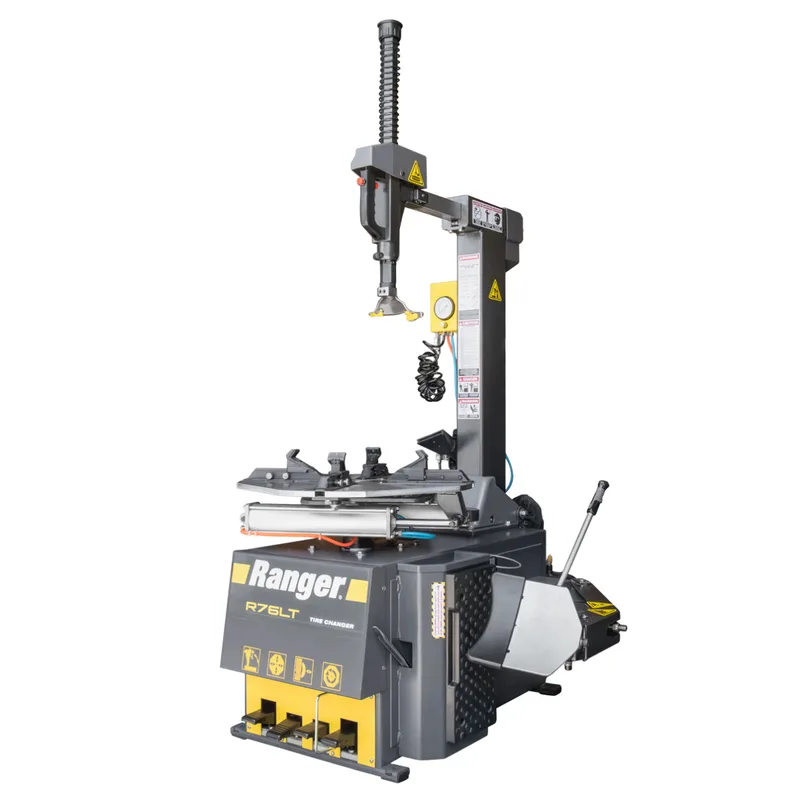
Here's what changes once real air is on the wall. Wheels come off in seconds with an impact gun instead of a breaker bar. The tire machine actually works the way it's supposed to (and if you're looking at one, our tire changer guide is worth a read). You blow the dust off the bench in five seconds. And you start taking on sanding, blasting, and spray work you used to send out.
And it's quiet enough to have the radio on.
That's the garage people picture when they say "dream garage." Not just a lift and a clean floor, but a room where every tool is ready the second you reach for it.
The short list
If you're building out a serious home shop, here's the air setup we'd spec:
- BendPak TSP-580V-601 80-gallon, two-stage compressor, $4,395
- Anti-vibration pads, $76
- 3/4" hard line around the perimeter with a drop at every bay
- Ranger RH-50PL hose reel over the lift, $496
- BendPak air compressor accessory kit for couplers, a blow gun, and an inflator, $50
The compressor ships by freight with liftgate delivery anywhere in the lower 48, and every BendPak machine we sell is covered by the full manufacturer warranty because we're an authorized dealer. Browse the rest of the BendPak shop equipment line, or check out the Ranger brand page for jacks, presses, and the rest of what goes on the other end of that hose.