How to Heat a Garage in Winter Without a Bigger Heater
Every January the same thing happens. You run the heater from eight in the morning, come back at nine with coffee, and the air at head height feels fine while your feet are going numb on the concrete. So you turn it up. Then the propane bill lands in February and you start quietly doing math on whether the shop is worth heating at all.
The heater usually isn't the problem.
Take a 24 by 30 shop with a 12 foot ceiling. A big share of everything that heater made is parked in the top three or four feet of that room right now, and it is doing absolutely nothing for the guy lying on a creeper under a truck.
The heat you paid for is stacked against the ceiling
Warm air is less dense than cold air, so it climbs and then it stays climbed. Left alone in a tall heated space it settles into layers, warmest at the deck, coldest at the slab, and the taller the building the worse the spread gets. HVAC guys work off a rough rule of about a degree per foot of height in a room that isn't being mixed, which in a 14 foot pole barn puts the gap between your head and the trusses into double digits.
Cool Boss uses a twenty degree spread as the example case in its own product literature. That number isn't marketing.
So you've got two moves. Push more heat into a room that's already sending most of it upstairs, or go get the heat you already bought and paid for.
Buying a bigger heater is the wrong move
I'll say it flat out, because it's the first thing almost everybody does. Adding a second heater, or swapping in a bigger one, is the most expensive possible fix for a stratification problem. You end up paying twice. Once for the fuel, and again for the portion of that fuel that goes straight to the ceiling and sits there until you open the overhead door and lose it to the driveway.
Insulation helps. Sealing the door helps. Neither one moves the air that's already trapped up top.
What a big slow fan actually does
HVLS stands for high volume, low speed. But the low speed half is the part people underestimate.
A fan with an eleven and a half foot blade span turning at 90 RPM doesn't blow at you the way a shop fan does. It pushes a wide column of air straight down to the slab, out across the floor in every direction, up the walls, and back along the ceiling, which turns the entire room over instead of stirring one corner of it. In winter that column drags the ceiling heat back down to where you're actually standing.
Come summer the same fan puts moving air across your skin while you're bent over a fender, and that's worth several degrees of felt temperature by itself.
Two different jobs. One piece of equipment.
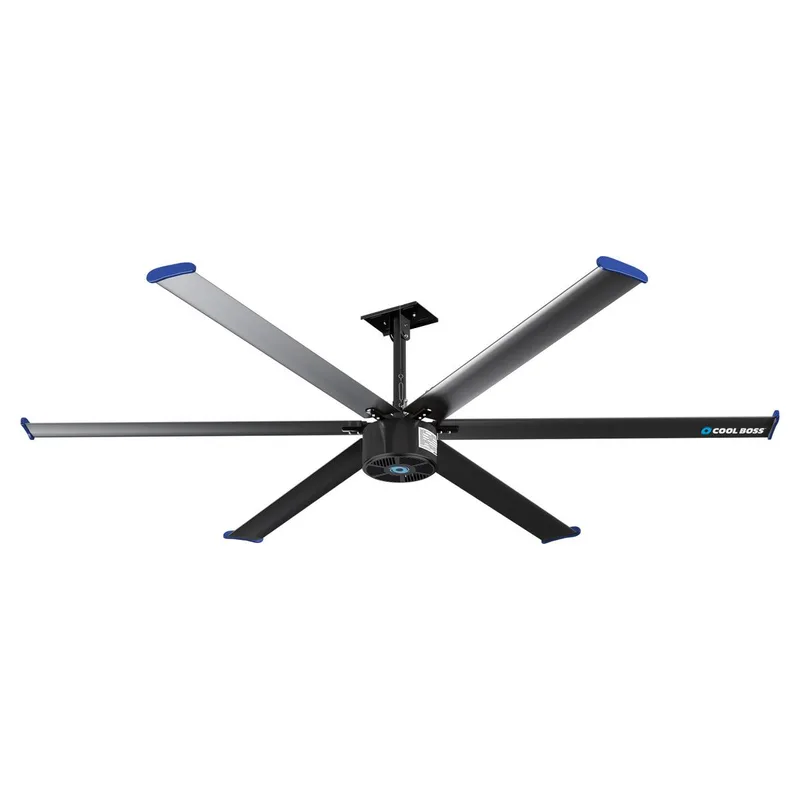
The Cool Boss CB-11HVLS
The Cool Boss CB-11HVLS is the one I'd hang in a home shop. It runs $3,995, it ships free, and the spec sheet doesn't oversell what it is.
Eleven and a half feet of blade span across six powder-coated aluminum airfoils, topping out at 90 RPM. Air volume is 148,321 CFM, which is a figure that means nothing on paper until you stand under it and watch every bit of dust on the floor decide to relocate. The motor is a direct-drive permanent magnet unit with no reduction gearing, so there's no gearbox, no gear oil, and nothing sitting on a maintenance schedule waiting to leak on your hood.
It runs at 40 dB. You can hold a normal conversation underneath it while somebody's running an impact on the other side of the shop.
Hanging weight is 152 pounds. It pulls 5 amps at 208-230 volts single phase, roughly 1,100 watts at full tilt, which is about what your microwave draws. The control cable runs close to 80 feet, so the switch lives on the wall by the man door instead of dangling in the middle of the bay. UL certified, ETL listed through Intertek, rated to operate from 5 to 131 degrees.
Cool Boss is a BendPak subsidiary. Same company that's been building lifts in Santa Paula, California since 1965, which is the reason the hardware feels like shop equipment instead of a ceiling fan with a big number on the box.
Ten feet of ceiling, minimum
The spec sheet lists a 10 foot minimum mounting height and you should read that as a hard floor, not a target. Motor and mount stack up about 10 inches, so on a 10 foot ceiling the blades sit right around nine feet off the slab. Fine to walk under. Not fine to raise a tailgate under.
Twelve feet is where this starts feeling right, and 14 is better.
If you run a two-post lift, don't hang the fan over the lift. A full-size pickup raised to working height puts the roof past 12 feet, and you do not want to find that out on the way up. Put the fan over the open floor instead, the bay you park in or the bench side, and let it move air through the whole room rather than fighting the lift for the same cubic feet. Our garage ceiling height guide walks through the lift clearance side of that math.
Mount it to structure. A truss, a purlin, a ridge beam, something an engineer would sign off on. 152 pounds of static weight plus a spinning load is not a drywall anchor conversation.
Power, and the electrician conversation
It needs 208-230 volts, single phase, on a dedicated circuit, hard-wired. If you already pulled 240 out to the garage for a lift, a welder, or a compressor, you're most of the way there and this is a short afternoon for a licensed electrician.
If you haven't, price that drop before you price the fan. It's the part of the project people forget to budget.
What it will not do
This is not a heater. It doesn't add one BTU to the room.
If your shop has an uninsulated steel door with daylight showing around the frame, mixing the air just distributes the cold more evenly, and you'll have spent four grand to be uniformly uncomfortable. Insulate, seal, then mix. In that order.
It also won't do much in a garage with an 8 foot ceiling, because there's no meaningful layer up there worth going after. A box fan and a better door seal will serve you better and cost about two percent as much.
The July argument
Anybody heating a garage in Ohio in January is cooling that same garage in July, and this is where the fan quietly pays for itself twice. Run it alongside a Cool Boss evaporative cooler and the fan carries that chilled air out of the corner it was aimed at and spreads it across the entire slab. We covered that setup in detail in how to cool a large garage.
Bigger building, bigger fan. The CB16HVLS spans 16.4 feet and moves 10,200 cubic meters a minute, and the CB20HVLS goes to a 20 foot span at 12,700. Those are pole barn and shop building numbers, not two-car garage numbers. The rest of the lineup sits under cooling systems.
Go measure your ceiling before you do anything else, floor to the lowest structural member, and write the number down. Then look at the CB-11HVLS. If the room is still on paper, drop it into the garage builder and place it against real dimensions before you spend a dollar. The heat is already up there waiting.