Best Floor Jack for a Home Garage: Buy It Once
Every garage has a jack graveyard. It's the corner where the scissor jack from the trunk, the bargain-bin bottle jack and the 2-ton orange floor jack that started leaking down last spring all end up. Most people buy three cheap jacks over ten years before they buy the right one.
This time of year is when it shows. Late October through November is winter tire season across most of the country, and swapping four wheels twice a year is exactly the kind of job that tells you whether your jack is any good. A jack that creeps down while you're threading a lug nut isn't a tool. It's a liability.
So here's how to pick one floor jack you'll still be using in 2040, and the one we'd buy.
Capacity: buy 3 tons and stop thinking about it
A floor jack only lifts one corner or one end of the car at a time, so you don't need a jack rated for the full curb weight. But you do want real margin. A 4,500-lb crossover puts somewhere around 2,500 lbs on the front axle, and a half-ton pickup can put well over 3,000 on the nose.
A 3-ton (6,000-lb) jack covers every car, crossover, SUV and half-ton truck most people will ever park at home. Anything rated at 2 tons is cutting it close on a modern SUV. Anything bigger than 3 tons is usually heavier and taller than a home garage needs.
Three tons. Done.
The specs nobody reads
Capacity is printed in big letters on the box. These three numbers matter more and they're always in the fine print.
Lowered saddle height. This is how low the lifting pad sits when the jack is collapsed. If it won't slide under your jacking point, the capacity doesn't matter. Most stock cars, trucks and SUVs are fine with a saddle under 5 inches. Lowered sports cars need less, and that's a different jack entirely (more on that below).
Raised height. How high the saddle goes at full stroke. You need enough lift to get a tire fully off the ground and still slide a jack stand underneath. On a truck with a lot of suspension droop, a short-stroke jack runs out of travel before the tire clears.
Frame length. A longer chassis lets you reach the center jacking points under the engine cradle or rear differential, which means you can lift a whole end at once. That's the trick that turns a winter tire swap from eight jack placements into two.
Weight is the hidden fourth spec. Heavy steel jacks are stable and durable, and that's what you want if the jack lives in your garage. If it rides in a trailer to the track, aluminum makes more sense.
Our pick: the Ranger RFJ-3T
The Ranger RFJ-3T is the floor jack we'd put in our own garage. It's a 3-ton professional steel service jack from Ranger, BendPak's shop equipment line, and it sells for $480 with free shipping to the contiguous US.
Here's what you get:
- 6,000-lb lifting capacity
- 4.75" lowered saddle height
- 20.5" maximum raised height
- 28" chassis length
- Flanged side plates for extra frame strength
- Double-sealed hydraulics
- 86 lbs shipping weight
That 4.75-inch saddle slides under almost every stock car, truck and SUV on the road. And 20.5 inches of lift is plenty to get a full-size truck tire off the slab with room for a stand underneath.
The flanged side plates are the detail that sold us. Cheap jacks use flat stamped sides that flex under a heavy load, and that flex is part of why they wobble when the car is halfway up. The flanges stiffen the whole frame. Double-sealed hydraulics are the other half of the story, because a slow seal leak is what kills most budget jacks in their third or fourth year.
It's not light. At 86 lbs, this jack lives on your garage floor, not in your trunk. For a home shop, that's exactly where it belongs.
When a different jack makes more sense
Not every garage needs the RFJ-3T. Two situations call for something else.
You've got a lowered car. If you can't fit a fist under your front lip, check out the Ranger RFJ-3000LPF at $575. It's a 1.5-ton super-long floor jack built specifically to reach the jacking points on low ground-clearance cars, and the extended frame gets under the car without the jack body hitting the bumper cover.
The jack goes to the track. The Ranger RFJ-3000AL is a 1.5-ton aluminum racing jack for $406. It's a lot easier to throw in a trailer for track days or autocross. But 3,000 lbs is a car jack, not a truck jack, so don't buy it as your only jack if there's a pickup in the driveway.
And if you just want a solid 3-ton steel jack for a little less, the Ranger RFJ-3TP runs $380 and uses a plunger-style release that gives you very fine control on the way down.
A jack is half the system
A floor jack lifts. It does not hold.
Every hydraulic jack can bleed down, and every car on a single jack is one bumped handle away from falling. The jack's only job is to get the car up so you can put it on stands. Then the jack comes out or sits there loose as a backup, never carrying the load while you're under the car.
We'd pair the RFJ-3T with the Ranger RJS-6T jack stands. They're rated at 12,000 lbs per pair, so they've got the same comfortable margin as the jack, and they cost $150 for two. Buy two pairs if you want to get a whole car in the air for brake work or a suspension job. If you only drive cars and small crossovers, the Ranger RJS-3T is an $80 pair rated at 6,000 lbs with a ratchet-and-pin lock that holds under load and a wide 7.5 x 7 inch base.
A few habits that keep you safe on stands:
- Work on flat, clean concrete. Never on asphalt in summer, never on gravel.
- Chock the wheels that stay on the ground before you lift anything.
- Put the stands under the pinch welds, frame rails or the manufacturer's listed support points. Your owner's manual shows them.
- Lower the car onto the stands, then give it a firm shove. If it moves, it comes back down and you start over.
For the full version of this, read our car lift safety guide. Most of the same rules apply on stands.
The two-jack-placement tire swap
This is where a long-chassis jack pays you back every spring and every fall.
Roll the RFJ-3T under the front crossmember jacking point (check your manual, it's usually a reinforced pad or the subframe). Lift until both front tires clear the floor by an inch or two. Set a stand under each front support point and lower the car onto them. Swap both front wheels. Then do the same at the rear differential or rear jacking point.
Two lifts, four wheels. On a car with locking lug nuts and a 1/2" impact, the whole swap takes about 20 minutes. Torque the lugs to spec with a hand torque wrench once the car is back on the ground, then check them again after the first 50 miles.
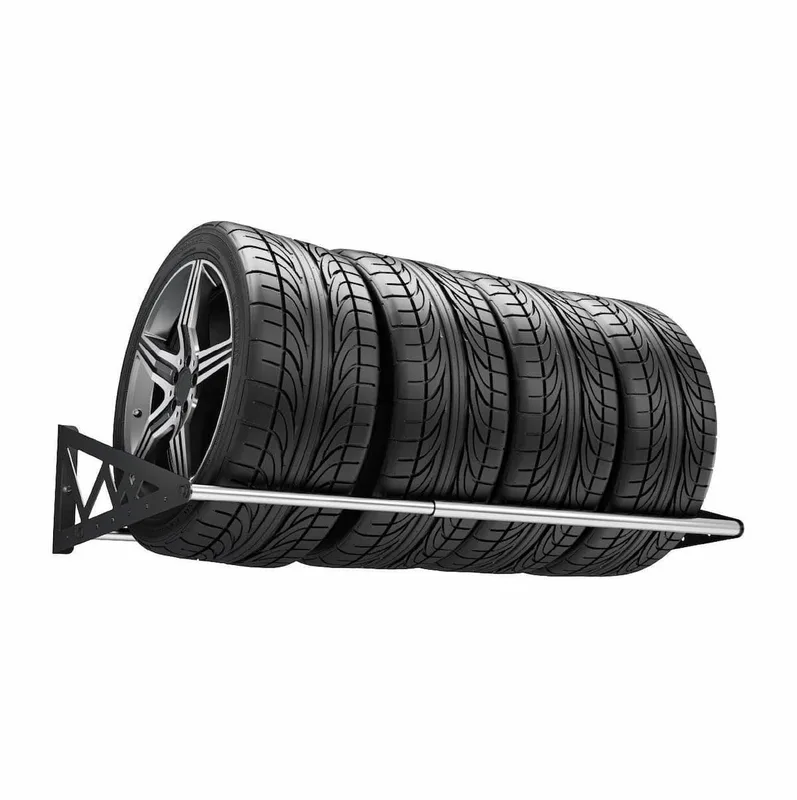
Done right, you'll never pay a shop to swap seasonal tires again. Then put the off-season set somewhere smart. Our post on how to store tires in a garage covers what UV and ozone do to rubber and where the set should actually live.
When to stop jacking and start lifting
Look, a good jack and four stands will handle brakes, oil, tires and most suspension work for years. But if you're spending every other weekend on your back on cold concrete, it's time to think about a lift.
The step up from a jack is smaller than most people think. A low-rise scissor lift gets the whole car to working height for wheel and brake jobs, and a portable car lift fits in garages with standard 8-foot ceilings. Even then, you'll keep the floor jack. Every shop with a two-post lift still has a good floor jack rolling around, because some jobs just need a corner up fast.
Start with the jack
If your current jack has ever crept down on its own, it's done. Replace it before the first snow.
The Ranger RFJ-3T and a pair of RJS-6T stands are the kit we'd buy once and keep for decades. See everything else Ranger makes for the home shop on the Ranger brand page, or map out where the jack, stands and a future lift will live with the Dream Garage Builder.