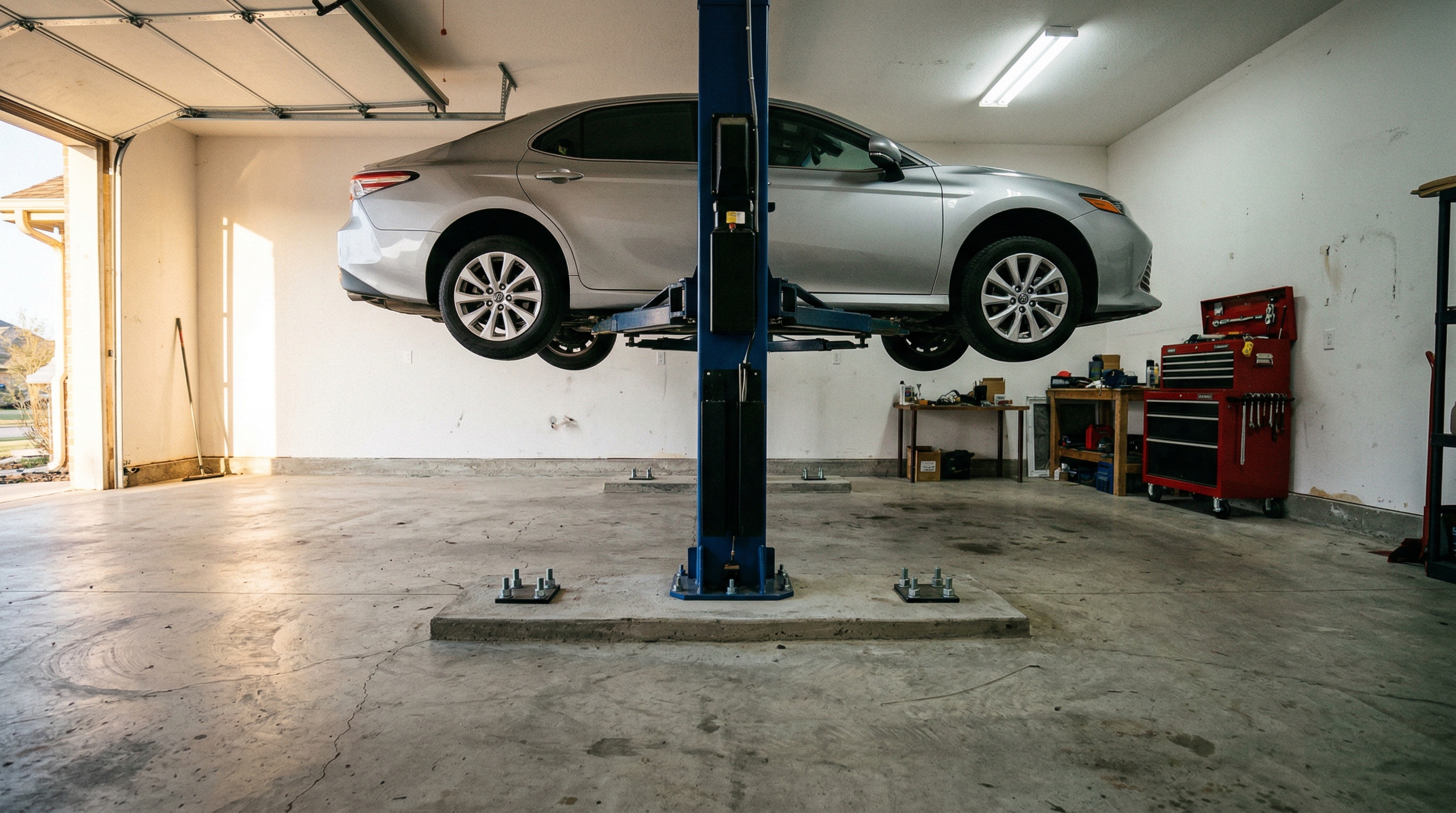
The Right Way to Store a Classic Car in Your Garage
There's a covered car in half the garages in America that hasn't moved since October. A Chevelle, an air-cooled 911, a Fox body, a Miata that got replaced by a truck. It sits in the best bay in the house, it holds a parking space hostage twelve months a year, and it gets driven maybe nine times.
That car isn't resting.
Sitting still is work, and your concrete floor is doing most of the damage while you sleep.
Sitting still is harder on a car than driving it
Tires go first. A set parked in one position for four months takes a set at the contact patch, and those flat spots sometimes roll out after twenty minutes of heat. Sometimes they don't, and you're buying tires in the spring.
Then the rotors. Cast iron plus damp air equals surface rust in about a week, and a parking brake left engaged all winter can rust the shoes right to the drum.
Mice don't care what the car is worth. They want the sound deadening, the seat foam, and the wiring loom, and a car that never moves is the safest apartment on the block. Every collector I know has one story about a chewed-up loom behind a dash, and the repair on that is measured in weekends, not hours.
Your slab is wetter than you think
Concrete moves water. A slab poured without a vapor barrier, which describes a lot of houses built before the mid-1980s, pulls groundwater up through the pad and releases it into the garage as vapor.
There's a two-dollar test for this. Tape a two-foot square of plastic sheeting flat to the floor and leave it overnight. Check the underside in the morning. If it's beaded with condensation, your slab is breathing water onto the bottom of your car every night it sits there.
That's the air surrounding the floor pans, the frame rails, and the exhaust of a car parked three inches off the concrete. All winter. Nobody notices until they get it on a lift and find the rockers gone soft.
Wheels down, not hanging
There's a long argument in every forum about storing a car on jack stands with the suspension hanging free. Don't.
Coil springs handle it fine. Bushings, ball joint boots, and CV boots do not, because full droop parks them at the outer edge of their travel for months at a stretch, and old rubber takes a set exactly where you leave it. Shock seals aren't crazy about full extension either. Store the car on its own wheels with the suspension loaded the way the engineers intended it to sit, air the tires up to the sidewall max before it goes to sleep, and drop them back to spec in the spring. That handles flat spots better than hanging the car ever did.
But wheels down creates the exact problem you were trying to solve. A car sitting on its tires takes up a parking space, and that space is the whole reason you started looking at this.
A lift that stores the car and then disappears
This is what a parking lift is for, and the Autostacker A6S is the one I'd put in a home garage.
It's a scissor-style platform lift rated at 6,000 lbs. The classic drives up the entry ramp onto a platform just over 141 inches long and stays on its own four tires the entire time it's up there. No lift points to find, no pinch weld adapters, nothing pressing against a 55-year-old rocker panel. Wheels on a deck.
At the top lock you get 85 inches of underside clearance with 76 inches of drive-thru clearance at the crossmember, so a daily driver parks underneath in the same footprint the classic used to hog by itself. Five locking positions on a self-locking ratchet. Forty-five seconds from flat to full rise.
The part that separates it from a four-post: it collapses. When the classic comes down in April, the platform folds to a low profile you drive straight over, and your garage goes back to being a garage. A four-post like the HD-9XW is a permanent structure in your bay whether there's a car on it or not, and that's a real trade if you only need the storage half the year.
The A6S Standard Package is $12,995 in 220V. Park anything with long doors up top and the extra-wide A6W buys you 8 more inches of interior width for $14,195, which matters a lot more than it sounds like when you're climbing out of a car five feet off the ground. There's a fully galvanized version at $15,995 if the lift is going under a carport or on an outdoor pad.
Do the ceiling math before you spend a dollar
This is where most parking lift purchases go sideways.
The math isn't complicated. Take the lock height you plan to use, add the overall height of the car going up top, then add about 3 inches so the locks have room to release. That total is the clear ceiling you need.
Run it with a real car. A C2 Corvette stands right around 49.8 inches tall. Park it at the A6S top lock and you're looking at 85 plus 50 plus 3, so call it 138 inches, or 11 feet 6 inches. Plenty of newer custom builds have that. Most 1990s tract garages come up short.
You don't have to run the top lock, though. That's what five positions are for. Drop to a middle lock and the ceiling requirement falls with it, and the trade is simply what fits underneath, a Miata instead of a Tahoe. Measure to the lowest thing hanging up there, not to the drywall. Garage door tracks, opener rails, and light fixtures are what people forget, and they're always lower than you guessed.
Our Dream Garage Builder lets you plug in your real dimensions and see the stack in 3D before anything ships. And if you're still deciding between lift styles altogether, the ceiling height guide breaks down the numbers for every type we carry.
Power and concrete
The A6S runs on 208-240V single phase and pulls 11 amps through a 3 HP motor. So you need a 220 circuit in the garage, the same kind of service a welder or a dryer wants. No 220 out there yet? Budget $400 to $900 for an electrician and get it done before a freight truck shows up with 2,516 lbs of lift on it.
Concrete matters less here than it does with a two-post, because nothing is anchored into your slab fighting a tipping load. It still matters. Four inches of sound 3,000 PSI concrete is the floor, and cracked pads and expansion seams are a hard no. If you have no idea what's under your floor paint, start here.
The rest of the routine
Fuel first. Fill the tank nearly full and add stabilizer, then run the engine long enough to pull treated fuel through the lines and into the carb or the rails. A half-empty tank rusts from the inside out.
Battery goes on a tender, not a trickle charger on a timer.
Change the oil before storage rather than after. Used oil carries acids and you don't want those sitting on bearing surfaces for six months.
Cover it with something breathable. Plastic tarps trap moisture against paint, and that's how you end up with water spots no amount of polishing takes back out.
Floor is the one everybody skips. Ribtrax Pro tiles sit on a raised grid above the slab so air actually moves under the car instead of pooling against rubber and steel. If your plastic sheet came back wet in the morning, that's the fix, and it costs a fraction of what the rust repair would.
Come April you hit the release, the platform drops in forty-five seconds, you back the car out into the sun, and you fold the whole thing flat behind you. That's classic car ownership worth having. The car gets stored the way it deserves, and you get your garage back for the eight months you actually use it.
Have a look at the Autostacker lineup if you're done parking around your favorite car.