How Much Does a Car Lift Cost? Real Home Garage Numbers
The sticker price on a car lift is the number everybody quotes, and it's the number that gets people in trouble. A two-post lift listed at $6,000 can turn into a $9,000 project once the electrician, the concrete guy and the installer send their invoices. Or it can stay at $6,500 if your garage is already set up right.
The difference is all in the prep. So here's what a home garage lift really costs in 2026, line by line, with the actual prices on the lifts we sell and the side costs nobody puts on the product page.
What the lift itself costs
Lift prices fall into four clear bands. These are current prices on lifts we carry, all shipping free to the contiguous 48 states.
| Lift type | Example | Price | Capacity |
|---|---|---|---|
| Portable frame lift | QuickJack 6000TL | $1,925 | 6,000 lbs |
| Portable 2-post | MaxJax M7K | $5,195 | 7,000 lbs |
| Full-rise 2-post | BendPak 10AP | $6,095 | 10,000 lbs |
| 4-post storage/service | BendPak HD-9 | $6,095 | 9,000 lbs |
Above that you're into premium territory. The 10AP-168 Pro Series runs $7,545 and the taller 10APX-181 Pro Series is $8,445. Platform parking lifts from Autostacker start around $12,700.
You'll see cheaper lifts online. Plenty of them. The gap usually comes down to two letters -- ALI. An ALI-certified lift has been independently tested to the ANSI safety standard, and an uncertified import hasn't. You're going to stand under this thing. That's not where you save $1,500.
The costs that aren't on the product page
This is where budgets break. Every one of these depends on your garage, so walk out there with a tape measure before you add anything to a cart.
Electrical: $0 to $1,500
Most full-size two-post and four-post lifts run on a 220V single-phase power unit. If your garage already has a 220V circuit near where the lift will go, you're at zero. If not, a new dedicated circuit typically runs $300 to $800, and closer to $1,000 to $1,500 when the panel is on the far side of the house.
Portable lifts dodge this entirely. The QuickJack 6000TL and MaxJax M7K both run on 110V. Our car lift electrical requirements post has the breaker sizes and wire gauges if you want to price the job yourself.
Concrete: $0 to $3,000
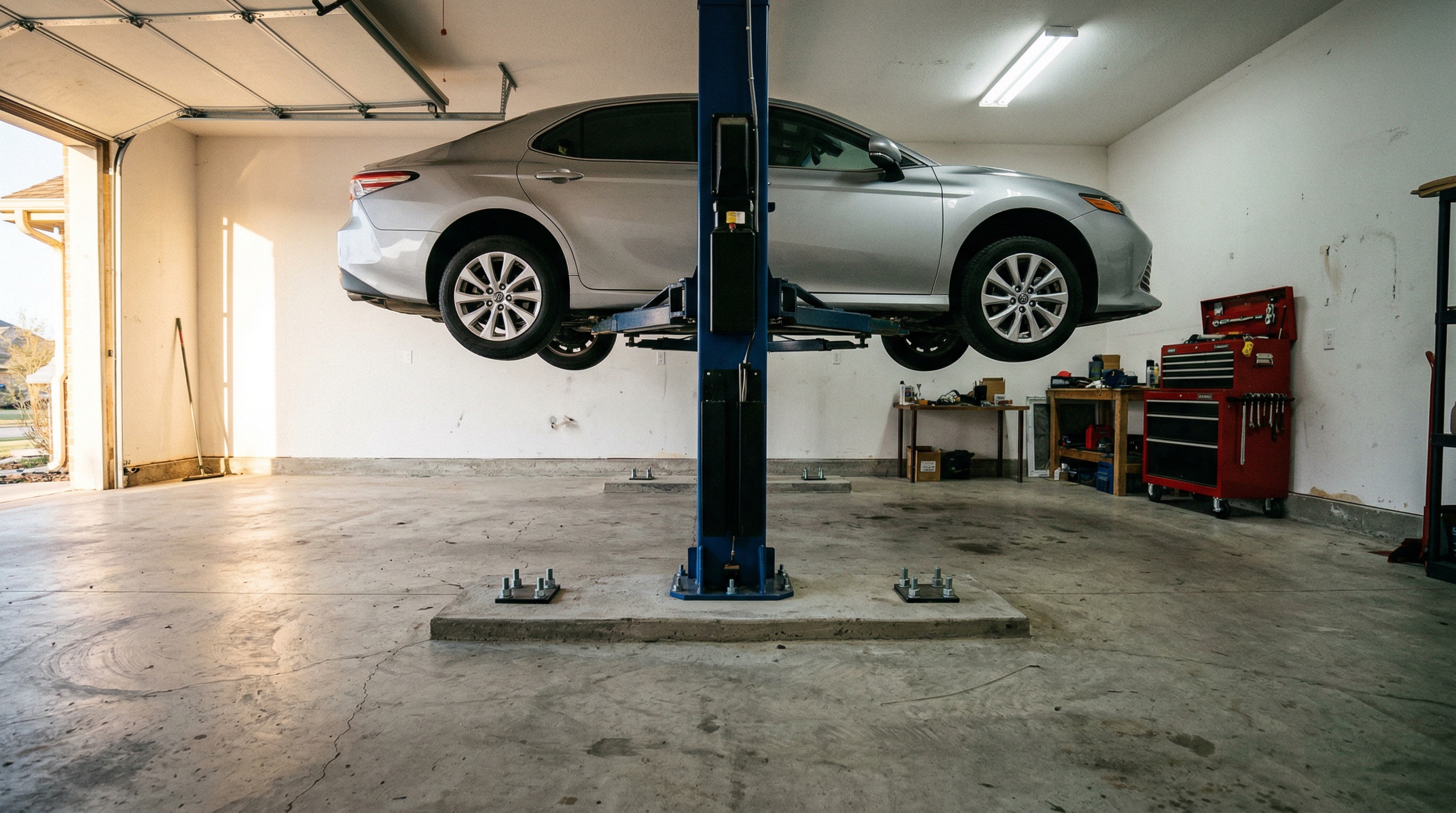
A two-post lift hangs the whole car on eight anchor bolts. BendPak wants a minimum of 4 inches of 3,000 PSI concrete under the columns, with no cracks or expansion seams in the anchor zone.
Most houses built after 1990 pass. If you're unsure, a core test costs $200 to $400. If the slab fails, cutting out two pads and pouring new reinforced footings runs $1,500 to $3,000. Four-post lifts spread the load across four feet and are far more forgiving, which is one more reason they're the safer bet on an older slab. Full details are in our concrete floor requirements guide.
Ceiling height: $0 or a lot
This one is binary. Either your ceiling works or you're looking at a different lift.
The BendPak 10AP stands 145 inches tall at its overall height, a little over 12 feet, and the overhead shutoff bar sits at 139.5 inches. If your garage door track or opener hangs lower than that, you either pick a lower lift or pay to convert the door to a high-lift track, which commonly runs $800 to $2,000. Raising a roof is a five-figure job and rarely worth it. Check the ceiling height guide before you fall in love with any lift.
Installation: $0 to $1,500
You can install a two-post lift yourself if you're handy, own a hammer drill and have two strong friends for the day. The 10AP ships on a freight truck at 1,729 lbs, so plan how you're getting it off the truck before it shows up.
Most people hire it out. Professional installers commonly quote somewhere between $500 and $1,500 for a standard two-post, depending on your region and how far they drive. Four-post lifts are freestanding and don't need anchoring in most home setups, so the install is simpler and cheaper.
The small stuff: $100 to $300
Hydraulic fluid, a couple of anchor bits, and maybe a set of truck adapters or frame pads. Not big money, but it shows up.
Three real budgets
Here's how it adds up for three common garages.
The 8-foot ceiling garage. QuickJack 6000TL at $1,925, plugged into an existing 110V outlet. No concrete work, no install. You're under $2,100 with a couple of extras and you'll be lifting a car the afternoon it arrives.
The lift-ready garage. BendPak 10AP at $6,095, 12-foot ceiling, decent slab and a 220V circuit already on the wall from a previous welder or compressor. Add $1,000 for a pro install and $200 for fluid and odds and ends. Call it $7,300 all in.
The full-prep garage. Same 10AP, but you need a new 220V circuit ($700), a door track conversion ($1,200) and new footings ($2,000), plus the $1,000 install. Now you're near $11,200. Still a great lift. It just helps to know that before you start, not after.
That spread is the whole reason the "average cost" numbers you see online are useless. Your garage decides.
Our pick: the BendPak 10AP
If your garage has the height for it, the BendPak 10AP is the two-post lift we'd budget for. At $6,095 it's the least expensive way into BendPak's new AP series, and it's in stock now.
The numbers that matter:
- 10,000-lb lifting capacity, 2,500 lbs max per arm
- 69 inches of rise, 73 inches with pads
- 4-inch minimum pad height, low enough for most lowered cars
- 45 seconds to full rise
- Adjustable top beam for a narrow or wide setup, with 92 or 102 inches of drive-thru clearance
- Safety locks in each column every 3 inches
- ALI certified
The adjustable width is the part we like most for a home garage. Set it narrow and you keep more of your floor. Set it wide and a full-size pickup drives between the columns without drama. The Bi-Metric arms work symmetric or asymmetric, so the same lift handles your daily driver and the half-ton.
And the safety design is a real step up from the older generation of two-post lifts. BendPak's automatic arm restraints hold the swing arms with over 2,000 lbs of locking force, so the arms don't wander when you pull a heavy part and the car's balance shifts.
Is 10,000 lbs more than you need? For a sports car, sure. But capacity margin is cheap on a two-post, and you'll own this lift through two or three vehicle changes. Buy for the truck you might own in 2032.
When to spend more, and when to spend less
Spend less if your ceiling is under 11 feet or the garage still has to park two cars every night. A QuickJack or the MaxJax gets you under the car for a third of the money and packs away when you're done.
Spend the same on a four-post if storage matters more than wheel-off work. The HD-9 costs exactly what the 10AP does and doubles a parking spot. Our 2-post vs 4-post comparison goes deep on that call.
Spend more on the 10APX-181 Pro if you've got 14-plus feet of ceiling and you're tall. Standing fully upright under the car for an exhaust job is worth the extra money.
What it pays back
Look at your last three shop invoices. Brake job, suspension work, an exhaust leak. Labor on those usually runs $100 to $500 a visit, and every one of them is easier on a lift than on your back on cold concrete. Do the math on two or three jobs a year and a $7,300 lift starts paying itself off in a few seasons. And that's before you count the Saturday mornings.
Start by checking your ceiling, slab and power against the 10AP specs. Then drop the lift into the Dream Garage Builder to see how it fits around your cars and workbench. When the numbers work, the BendPak 10AP ships free to your door, and the rest of the lineup is on the BendPak brand page.