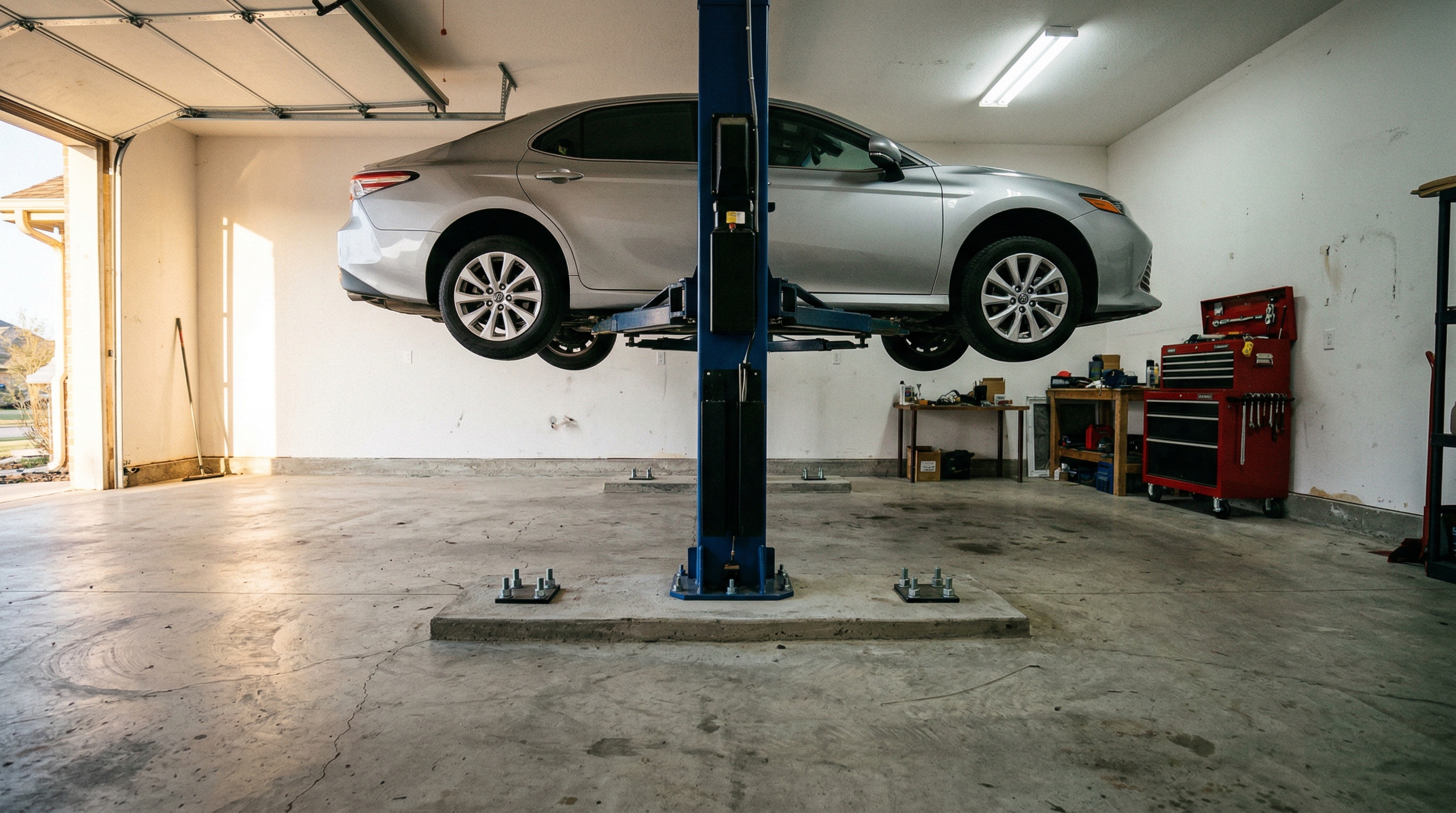
The Best Car Lift for Trucks and SUVs at Home
Most "best home garage lift" roundups are written for a Miata.
That's the problem. The average person shopping for a lift right now drives an F-150, a Silverado, a Tahoe, or a Tundra. Trucks and SUVs break the assumptions those articles are built on. They weigh more, they're longer between the lift points, and they sit higher off the ground before a jack ever touches them. The lift that works beautifully under a Civic will either run out of capacity or, more often, physically fail to reach where your truck wants to be picked up.
I've watched people buy the wrong lift twice for the same truck. Once because they shopped on the capacity number alone. Once because nobody told them about the spec that actually decides the whole thing.
Your truck weighs more than you think
Curb weight sneaks up on people.
A 2026 F-150 SuperCrew 4x4 sits somewhere between 5,200 and 5,700 lbs depending on the engine and the box. A Silverado 1500 Crew Cab runs about 5,100 to 5,500. Tahoe 4WD lands near 5,600 to 5,900. An Expedition Max clears 6,000 without trying. Now add a full tank, a bed liner, a steel toolbox, and a set of 35s, and you're another 200 to 400 lbs deep before anyone climbs in.
So a 6,000-lb lift is a lot tighter than the marketing makes it sound. You want real headroom above your loaded weight, not a rating that barely clears the brochure figure. For half-ton trucks and full-size SUVs, 8,000 lbs is the number to shop for.
Three-quarter-ton diesels are a different animal entirely. A Ram 2500 Cummins crew cab or an F-250 Power Stroke runs 7,400 to 8,000 lbs empty, which is at or past the ceiling of every portable lift built today. If that's your truck, you need a floor-anchored two-post rated at 10,000 lbs or better. No portable is going to serve you honestly, and anyone who tells you otherwise is selling.
The spec nobody checks
Capacity gets all the attention. Lift point spread decides whether the lift works at all.
Every vehicle has a pair of pinch welds or frame points on each side where a lift is designed to grab. On a Miata those points sit close together. On a SuperCrew riding a 145-inch wheelbase they're spread way out toward the bumpers, and a standard-length portable frame just isn't long enough to span them.
Here are the real numbers from the two 8,000-lb QuickJack frames:
- 8000TL: 37" minimum to 60" maximum lift point spread, 70" frames
- 8000TLX: 43" minimum to 66" maximum lift point spread, 76" frames
Six inches doesn't sound like much. It's the whole difference between a lift that fits your truck and 250 lbs of steel you have to freight back.
Measure before you buy anything. Get under the truck, find the factory lift points, and run a tape from the front point to the rear point on the same side. Over 60 inches means the standard frame is out. Under 43 inches on a small car means the extended frame is out. Both directions matter.
The lift I'd put in a truck owner's garage
The QuickJack 8000TLX Portable Truck Lift at $2,150 is what I point half-ton and full-size SUV owners toward, and it isn't close.
It's rated at 8,000 lbs. The frames run 76 inches with a 43 to 66 inch lift point spread, which covers essentially every half-ton crew cab and body-on-frame SUV sold in America today. Full rise takes about 30 seconds on a 1 HP power unit. Two mechanical lock positions hold the load, and a single-point safety release brings it back down when you're finished. A pressure-compensated flow divider keeps both frames climbing in sync, so the truck comes up level instead of walking on you.
Then the whole thing folds to 3.5 inches and rolls into a corner on its own urethane wheels.
That last detail matters more than most people expect in a two-car garage. Your lift isn't a permanent fixture eating a bay for the rest of its life. You drag it out Saturday morning, do a brake job, and by Saturday night the truck is back on the ground and the second car parks inside again. Each frame weighs 81.5 lbs, so moving it is a one-person job.
If your rig is shorter between the lift points, the standard-frame QuickJack 8000TL at $2,100 gets you the same 8,000-lb capacity in a 70-inch frame. Same brand, same build, different reach. QuickJack is a BendPak company, and the rest of the lineup lives on the QuickJack brand page.
Why a two-post is usually the wrong call here
An F-150 stands about 77 inches tall. A Tahoe is right around 76. Raise either one high enough to walk underneath and you're asking for well past 11 feet of clear ceiling, and that's before you account for the lift's own overhead beam and equalization cables.
Most American garages are framed at 8 or 9 feet.
That's the wall nearly every truck owner runs into. Ceiling height kills more home lift purchases than budget ever has.
If you genuinely have the room, a shop build or a barn or a 12-foot ceiling, then a floor-anchored two-post is the better tool and you should buy one. The BendPak 10APX-181 at $8,445 was designed around tall vehicles, with a 181-inch overhead beam and 10,000 lbs of capacity. It also needs 4 inches of properly cured concrete underneath it, so read our concrete floor requirements before you put money down.
For everyone else, the honest answer is 24 inches of lift and a creeper.
And 24 inches is a lot more useful than it sounds on paper. Wheels come off at a comfortable working height. You can slide under on a low creeper with a droplight and reach the exhaust, the transfer case, the fuel filter, and every drain plug on the truck. It's not standing-height access. It's also not lying in the driveway on cardboard in February, which is what most of us were doing before.
Ground clearance and the block stack
Lifted trucks add a wrinkle worth planning for.
The higher your rig sits, the farther your pinch welds are from the ground, and the more block height you need to reach them cleanly before the frames start rising. The 8000TLX ships with rubber blocks, and stacking taller ones changes your working numbers:
- Bare frame: 24" max lift height
- With a 2" block: about 21" of usable height
- With a 3" block: about 22"
- With adapters and the pin: 26.75"
A set of Tall Rubber Blocks 75mm runs $126 and is the accessory I'd buy alongside the lift on any truck wearing a leveling kit or a 4-inch suspension lift. If you'd rather get it all in one shipment, the 8000TLX Extended Frame Package at $2,375 bundles the lift with wall hangers and truck and SUV adapters.
Collapsed height is 3.5 inches, so a lowered car still clears the frames. That's the part people miss. One lift covers the truck in the driveway and the sports car in the back bay.
Running one is easier than wiring a two-post
The power unit pulls 10 amps at 110V and 1,100 watts. A standard household 15-amp outlet runs it. No 220V circuit, no subpanel, no electrician invoice, which is a real cost difference once you price out what a permanent two-post actually needs. We broke those numbers down in our post on car lift electrical requirements.
You need a flat, level, solid surface. That's the whole install list. No anchor bolts, no core drilling into your slab, no permanent hole pattern in a floor you might want to tile later. The lift spreads its load across two long frames instead of concentrating it into four anchor points, which is exactly why it works in garages that would never pass muster for a two-post.
Assembly is a couple of hours with basic hand tools. Everything ships free to the 48 contiguous states.
The math that pays it back
Shop labor on a truck is not cheap, and that's where the case for this really gets made.
A front brake job on an F-150 runs $400 to $700 at a shop. Full synthetic oil change on a 3.5 EcoBoost, $90 to $130 every time. Tire rotation, $25 to $50. Leveling kit install, $300 to $600 in labor alone. Exhaust work, driveline service, transfer case fluid, differential service, skid plate removal for anything at all.
Do four or five of those jobs a year and a $2,150 lift is paid off inside three years. Install your own lift kit and it happens in one afternoon.
But the money is honestly the smaller half of it. What actually changes is your relationship with the truck. Jobs you used to schedule around a shop's calendar become a Saturday morning thing. You stop putting off the fluid change you know it needs. You start catching the rust spot on the frame before it turns into a real problem, because you're under there looking at it every couple of months instead of never.
Building the rest of the bay around it
A lift is the anchor. The floor under it does more work than people give it credit for.
Modular tile handles the dropped sockets, the brake fluid, and the winter road salt that comes off a truck in sheets. It also makes a garage look like a garage you're proud of instead of a slab with oil stains. Our portable lift setup guide covers how the pieces fit together in a tight two-car space.
If you want to see it before you buy it, drop your real garage dimensions into the Dream Garage Builder and place the lift, the flooring, and the storage in 3D. It takes about ten minutes and it's a lot cheaper than finding out your frames don't fit after the freight truck leaves.
Measure your lift points this weekend. That one number tells you which frame you need, and everything else follows from there.