Brake Work on a 4-Post Lift: Add a Rolling Bridge Jack
The one complaint every 4-post lift owner eventually makes is the same. The car goes up beautifully, it sits rock solid on the runways, you can park a second car underneath it -- and then you want to swap the winter tires and realize the wheels are sitting right on the steel.
A drive-on lift holds the car by its tires. That's what makes it so easy to use and so stable for storage. It's also why it can't do wheel work by itself.
This comes up constantly on r/garageporn and r/askcarguys. Somebody is planning a lift for a new house, they want the parking of a 4-post, and someone in the comments tells them to buy a 2-post instead because "you can't do brakes on a 4-post." That advice is half right. You can't do brakes on a bare 4-post. Add a rolling bridge jack and you can do brakes, tires, suspension and wheel bearings without ever moving the car off the lift.
What a Rolling Bridge Jack Actually Is
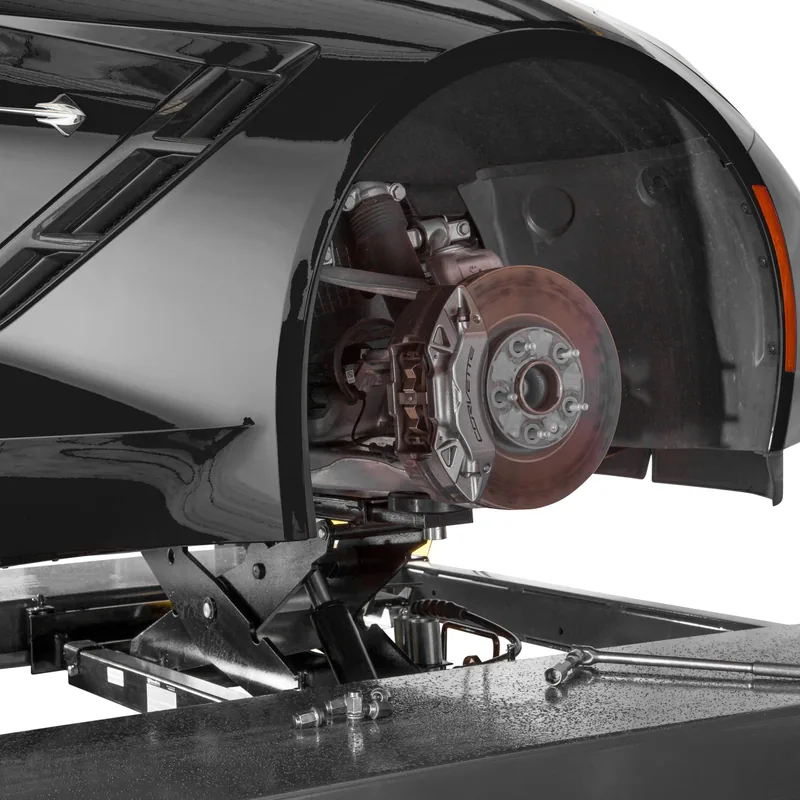
It's a short, wide air-over-hydraulic jack that rides between the two runways of a 4-post lift. Its wheels sit in channels along the inside edge of each runway, so you roll it fore and aft to wherever the car's lift points are. Set the arms under the pinch welds or frame, hit the air, and the jack lifts that end of the car off the runways.
Now the wheels hang free. The car is still sitting over a 9,000-lb. lift, still at standing height, and you've got the same access to the hubs you'd get on a two-post.
Most home garages need one jack. Do the fronts, lower it, roll the jack back, do the rears. Shops and people who rotate tires every few weeks buy two so the whole car comes off the runways at once.
The Hero Setup: BendPak HD-9 Plus the RJ45W
If you're building around a 4-post for a home garage, this is the pairing we'd point you at first.
The BendPak HD-9 ($6,095) is the 4-post most home garages end up with, and for good reason. It lifts 9,000 lbs., gives you 70 inches of rise, and the runways sit 5 inches off the floor so lowered cars drive on without scraping the nose. It's freestanding, runs on 208-230V single phase,. BendPak rates the power unit at 45 dB, so it won't wake the house.
The BendPak RJ45W rolling bridge jack ($2,350) is the jack built for it. Here's what you're getting:
- Capacity: 4,500 lbs. per jack
- Pad height: 4.5 to 15.5 inches, so about 11 inches of travel on the pads alone
- With adapters: 7.25 to 18.25 inches on the 2.75-inch stack, 10 to 21 inches on the 5.5-inch stack
- Arm reach: 42 to 57 inches
- Base width: 35.5 to 46.5 inches
- Pump: air/hydraulic at 125 PSI, about 55 seconds to full height
- Fits: the runway channels on compatible 4-post lifts rated 7,000 lbs. and up
Look at that base width next to the HD-9's 35 to 41 inches between runways. That overlap is the whole reason the pairing works. The jack spans the gap on any runway setting you'll use.
So the math for a complete home service lift: $8,445 for the HD-9 and one RJ45W. Add a second jack and you're at $10,795. Both ship free to the lower 48 states.
Why Not Just Buy a 2-Post
Fair question. We wrote a whole 2-post vs 4-post comparison on it, and a two-post is the better pure service lift. Arms swing in, car goes up, every wheel is free and the center of the bay is wide open for transmission and exhaust work.
But a two-post doesn't park a car. It wants a 10-foot-wide bay with nothing in it, it needs anchors drilled into 4-inch, 3,000 PSI concrete, and most people won't leave a car hanging on arms for the whole winter.
The 4-post does three jobs. It stores a car with a second one parked under it, it does oil changes and exhaust work at standing height, and with the RJ45W it does wheel work. That's why we'd pick it for most two-car garages where the lift has to earn its floor space. The rest of the case for a parking setup is in our guide to doubling your garage parking.
And the HD-9 is freestanding. No anchors to set, and if you move, it comes with you.
You Need Shop Air
This is the part people miss when they order.
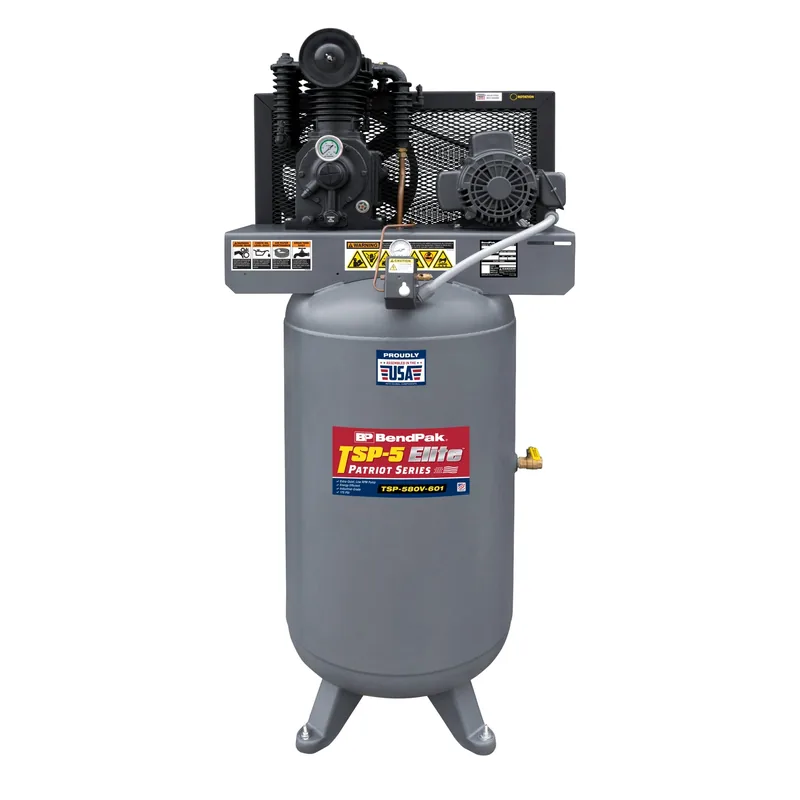
The RJ45W runs on compressed air at 125 PSI. No air, no lift. A pancake compressor will technically get it up, but it'll cycle the whole time and you'll be waiting on it before every lift. A 60-gallon stationary compressor on a 240V circuit is the right call for a garage that's going to run a bridge jack, impact guns and a tire inflator off the same line. We broke down sizing in our home garage air compressor guide.
Then get the hose off the floor. BendPak makes an airline kit for four-post bridge jacks that routes air along the lift to the jacks, so you aren't dragging a hose across the runway every time you roll the jack.
Doing a Brake Job on It
Here's how a front brake job goes on an HD-9 with one RJ45W, start to finish.
- Drive on, set the parking brake, chock the rear tires.
- Raise the lift to a comfortable working height and let it settle on the locks. Never work under a lift held up only by hydraulics.
- Roll the jack forward to the front lift points. Stack adapters until the pads are an inch or so under the pinch welds.
- Lift the front of the car until the tires clear the runway by a couple of inches. That's all you need.
- Pull the wheels and do the job. Calipers, rotors, pads, all at chest height instead of on your knees on cold concrete.
- Torque the lug nuts with the wheels back on, lower the jack, roll it out of the way, and bring the lift down.
The first time takes a while because you're figuring out your adapter stack. After that it's quick. And your back will thank you.
One rule matters more than the rest. Know what each end of your car weighs and never put more on a jack than its rating. A 4,000-lb. sedan carries roughly 2,200 lbs. on the front axle, which is nowhere near the RJ45W's 4,500-lb. limit. Heavy diesel trucks are a different story, and a truck that big belongs on a bigger lift anyway. Our car lift safety guide covers the rest.
Picking the Right Jack
BendPak makes several of these, and they're not interchangeable. Each one is sized to a runway width and a lift capacity.
The RJ45W is the default for HD-9 and HD-7 owners. If you work on low sports cars or modified chassis, look at the RJ45LP low-profile version ($2,325). It drops to a 4.25-inch minimum pad height and reaches 61 inches instead of 57. That extra reach helps when the lift points sit wide.
Bigger lifts take bigger jacks. The RJ6W ($2,425) is rated 6,000 lbs. and built for BendPak 4-post lifts rated 12,000 lbs. and higher. Don't buy one for an HD-9. It won't fit the runways.
If you're running a taller garage and want more room under the top car, the HD-9XW ($6,495) gives you 82 inches of rise, enough to park a full-size truck or SUV underneath, and BendPak lists the RJ45 as its matching rolling jack.
Ceiling and Floor Check
A bridge jack adds nothing to your ceiling math, which is nice. The car only comes up a few inches off the runway. Plan your ceiling around the lift and the tallest vehicle you'll park on top, the same as you would without the jack. Our garage ceiling height guide walks through the numbers.
Shipping is the other thing to plan for. The HD-9 ships on a flatbed at 1,616 lbs. and needs a forklift or a few strong friends with a plan to come off the truck. The RJ45W comes LTL at 378 lbs. with liftgate delivery.
If you want to see how an HD-9 fits next to your workbench, cabinets and second car before you order, drop it into the Dream Garage Builder with your real dimensions. Then browse the full BendPak lineup, or call us and we'll confirm the right jack for your lift before anything ships.