Symmetric vs Asymmetric Two-Post Lift: Which Fits You
Every two-post lift spec sheet eventually throws the same two words at you. Symmetric. Asymmetric. Some lifts claim to be both. And most of the explanations online either stop at "the posts are turned" or bury the useful part under a wall of engineering diagrams.
So here's the short version, from people who sell these lifts to home garages across the country every week. The difference comes down to where the car sits relative to the columns, and that decides three things you'll feel every single time you use the lift: how easily you get out of the car, how well the arms reach the lift points on your specific vehicle, and how the weight balances once the car is in the air.
Get those three right and the lift disappears into your routine. Get them wrong and you'll be shuffling arms, squeezing out of a half-open door and second-guessing the balance on every lift.
What symmetric and asymmetric actually mean
Start with the columns.
On a symmetric lift, the two columns face each other straight across the bay, and all four arms are the same length or very close to it. You drive in and center the car between the columns, front to back. The vehicle's middle sits right on the line between the posts.
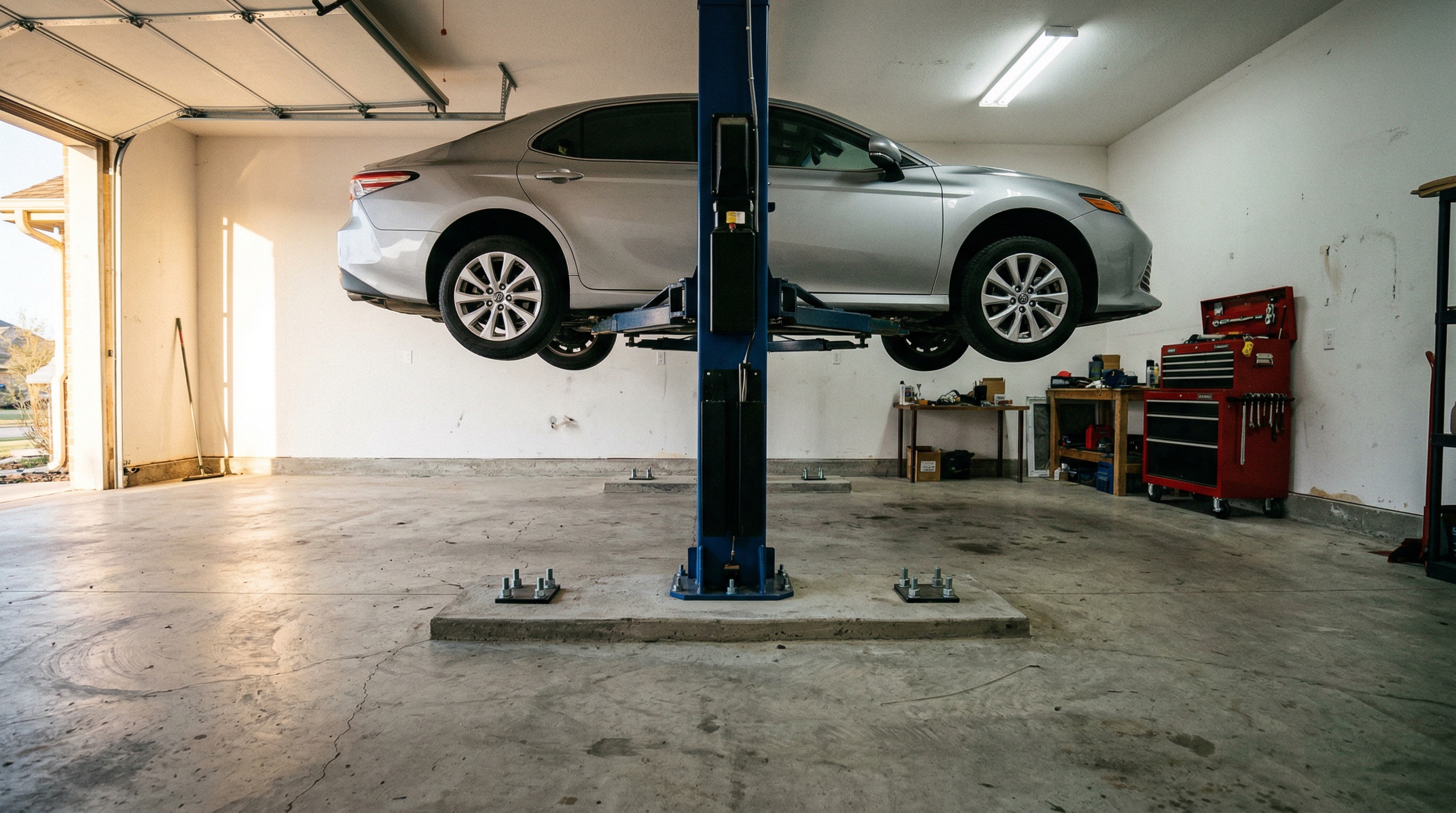
On an asymmetric lift, the columns are typically rotated so they face slightly toward the rear of the bay, and the arms are different lengths: short arms in front, long arms in back. You stop the car farther back than you would on a symmetric lift. The common rule of thumb is roughly a third of the vehicle ahead of the column line and two-thirds behind it.
That set-back position is the whole point. It moves the front doors behind the columns so they can swing open, and it lines the car's center of gravity up with the posts on a typical front-engine car.
Then there's the third category, which is where most of the good home garage lifts live now.
The "both ways" lifts
A lot of current two-post lifts don't force you to pick. They use arms with enough telescoping range that you can set the car up centered or set back, depending on what's on the lift that day.
BendPak calls its version Bi-Metric arms. APEX just lists "symmetric and asymmetric arm configurations." Either way, you get one lift that handles a sedan in the asymmetric position on Saturday and a long-bed pickup centered on Sunday.
For a home garage, this is the right answer almost every time. You don't own one car forever. The project car you buy in three years might have a completely different wheelbase than what's in the garage now, and a lift you can reconfigure in a minute protects you from that.
Door clearance is the part people underestimate
This sounds minor until you've done it 200 times.
On a pure symmetric lift, the columns sit right beside the front doors. Pull a midsize car in, center it, and the driver's door hits the column before it opens wide enough to get out comfortably. You either climb out through a gap, park off-center and fix it later, or get out before final positioning and push the car the last few inches.
Asymmetric positioning fixes that. With the car set back, the door opens past the column instead of into it. If you're lifting the same daily driver or weekend car over and over, that convenience matters more than any spec on the sheet.
Drive-thru width plays into it too. The BendPak 10APX gives you 92 to 102 inches between the columns depending on how you set the width, and that extra room makes door swing and arm setup easier on full-size vehicles.
Arm reach decides what you can actually lift
Here's where real numbers beat theory. Arm reach is listed as a minimum and a maximum, and your vehicle's factory lift points have to fall inside that range.
| Lift | Capacity | Front arm reach | Rear arm reach | Price |
|---|---|---|---|---|
| APEX AL10C | 10,000 lbs | 22.5 - 43.25 in | 33.5 - 53.25 in | $4,195 |
| BendPak 10APX | 10,000 lbs | 24.5 - 50 in | 32 - 59.25 in | $6,895 |
| BendPak 12APX | 12,000 lbs | 26 - 55.25 in | 29.25 - 60 in | $10,495 |
Look at the gap between front and rear on each one. That's how much asymmetric bias the lift can run. The 10APX's rear arms reach more than 9 inches farther than its fronts, which is plenty to set a car back for door clearance while still getting the front pads under the pinch welds.
Short-wheelbase cars are where asymmetric setups get tricky. A Miata, an older Mini, a short 2-door Bronco -- these have lift points so close together that a strongly asymmetric lift can struggle to get the short front arms and the long rear arms both in the right spots. People on Reddit and the Garage Journal forum say this constantly, and they're right. If you mostly lift small cars, you want arms that retract short, and you'll often run them closer to symmetric.
Long trucks and vans go the other way. Their lift points sit far apart and their frames are long, so centering them symmetrically between the columns usually works best. That's why heavy-duty lifts in the 12,000-lb and up class lean symmetric.
Center of gravity, the part that keeps the car on the lift
Every vehicle on a two-post lift needs its center of gravity sitting close to the line between the columns. That's not a suggestion. It's the first thing in every lift manual.
Most cars carry their weight forward because the engine is up front. Set a front-engine sedan dead center on a symmetric lift and the balance point ends up a bit ahead of the posts. Set it back in the asymmetric position and the heavy end lines up with the columns. That's why asymmetric geometry became the default for passenger car shops.
But balance changes while you work.
Pull a transmission out of a rear-drive car and the weight shifts forward. Drop the battery pack on an EV and you've just removed hundreds of pounds from the middle of the car. Pull an engine and the front gets light enough that the car wants to tip toward the rear. So the setup that was perfect when you lifted the car can be wrong an hour later. Use tall jack stands under the car before you pull anything heavy, and plan your arm position around the job, not just the vehicle.
This is also where arm restraints earn their keep. The 10APX uses BendPak's ASARS system, which locks each swing arm with more than 2,000 lbs of side-force resistance so the arms don't creep when the load shifts.
Our pick: the BendPak 10APX
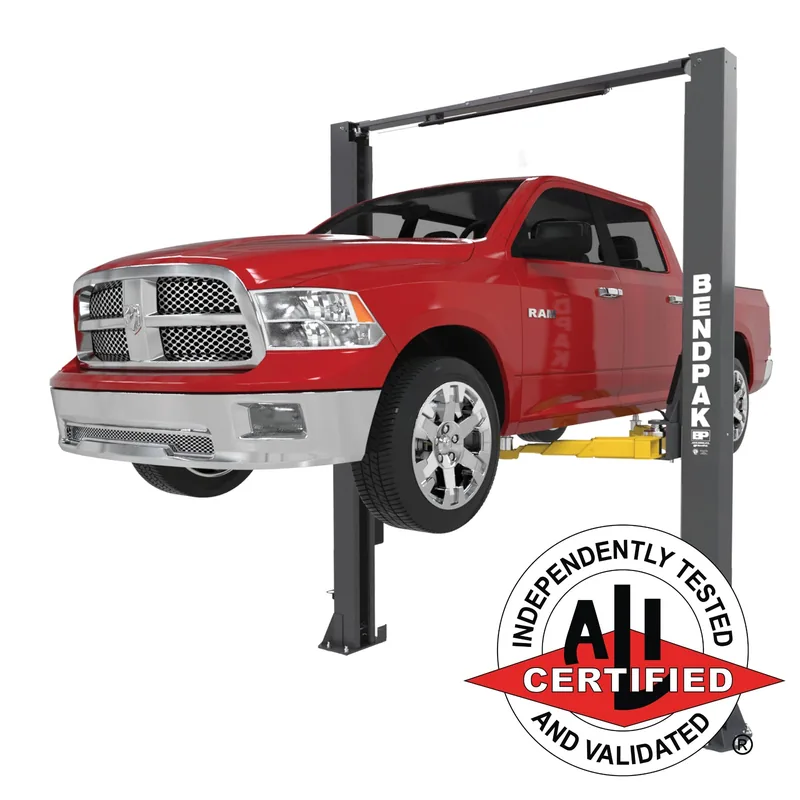
If you want one two-post lift that runs both setups and gives you real standing room underneath, buy the BendPak 10APX. It's $6,895 and it ships free to the lower 48.
It's the high-rise version of BendPak's 10AP platform, and the extra height is the reason to pick it over the standard model. Here's what you get:
- 10,000 lbs of lifting capacity, 2,500 lbs per arm
- 79.5 inches of rise with pads, so a 6-foot person can walk under most cars without ducking
- Pick-up height of 4 inches with pads, low enough for lowered cars thanks to the Low-Pro arms
- Bi-Metric triple-telescoping arms that run symmetric or asymmetric
- Adjustable width: 92 to 102 inches of drive-thru clearance, 127.5 to 137.5 inches outside the columns
- Safety locks every 3 inches in each column with a single-point release, so you don't walk around the lift to lower it
- Clearfloor design, nothing on the floor between the posts to trip over or roll a creeper across
- 45-second lift time on a 208-230V single-phase power unit
- ALI certified
That last line matters. ALI certification means the lift was independently tested to the ANSI safety standard, not just tested by the company selling it.
There's one catch. The 10APX stands 157 inches tall, a little over 13 feet. If your garage ceiling is 12 feet, this isn't your lift. Measure first, and check our garage ceiling height guide to see how rise, vehicle height and overhead clearance stack up.
If the 10APX doesn't fit your garage or budget
The APEX AL10C is the value play at $4,195. Same 10,000-lb capacity, symmetric and asymmetric arm setups, locks every 3 inches and a padded overhead shutoff bar. It used to sell as the GrandPrix and now carries the APEX name with a BendPak-backed 36-month limited warranty. You give up some arm reach (43.25 inches front max vs 50 on the 10APX), BendPak's ASARS restraints and a few inches of rise. For a home garage working mostly on cars, that's a fair trade for $2,700 back in your pocket.
Hauling heavier stuff? The BendPak 12APX steps up to 12,000 lbs with 3,000 lbs per arm and front arms that reach 55.25 inches. It's built for three-quarter-ton trucks, big SUVs and heavy EVs. It's also 169 inches tall and 156 inches wide, so it needs a big garage.
Low ceiling? Skip the overhead beam entirely. The BendPak 9APF is a floorplate lift built for garages that can't fit a 13-foot beam. You'll step over a cover plate between the columns, but you'll get a two-post lift into a space that otherwise couldn't take one.
Which setup should you run
Short answer for most home garages: buy a lift that does both, then use asymmetric for cars and symmetric for trucks.
Here's how we'd break it down by what's parked in your garage.
Run it asymmetric if you mostly lift sedans, coupes, sports cars or crossovers with the engine up front. You'll get door clearance and better balance out of the gate.
Run it symmetric if you lift long-bed pickups, vans, body-on-frame SUVs or anything with a long wheelbase and frame lift points. Centering these keeps the arms in their strong range.
Go closer to symmetric on short cars like Miatas, Minis and short-wheelbase off-roaders, because asymmetric front arms often can't reach their lift points.
Think about the job, not just the car. Pulling an engine, a transmission or a battery pack changes the balance, and you should set the car up for where the weight will end up.
And one strong opinion: don't buy a pure asymmetric lift with short fixed-ratio arms for a home garage. It locks you into one type of vehicle, and nobody's garage stays the same for 20 years.
Before you order any two-post lift
Three things kill more lift installs than the symmetric vs asymmetric decision ever will.
Ceiling height comes first. A high-rise lift like the 10APX needs more than 13 feet of clear height, and that includes clearance for your garage door track and opener. Low beams and door rails are the most common surprise we see.
Then concrete. A 10,000-lb two-post lift anchors into your slab, and the common minimum is 4 inches of 3,000 PSI concrete with no cracks near the anchor points. Check the install manual for your exact model, and read our concrete floor requirements guide before you drill anything.
Power last. The 10APX runs on a 208-230V single-phase circuit, which means a dedicated 220V line from your panel. Our car lift electrical requirements post covers wire gauge and breaker sizing.
Also plan for delivery. The 10APX ships on a flatbed at 1,840 lbs and needs a forklift or equivalent to offload, so line that up before the truck shows up.
Questions we get about lift geometry
Is an asymmetric lift safer than a symmetric one?
Neither is safer by design. Safety comes from loading the car correctly, using all four arms on the factory lift points, and buying a lift that's been through ALI certification. A symmetric lift with a truck centered properly is just as stable as an asymmetric lift with a sedan set back. Where people get hurt is putting a vehicle in the wrong position for its weight, then pulling a heavy part without support stands.
Can I lift a Tesla or another EV on an asymmetric lift?
You can, with the right adapters. EVs have specific jacking points and a battery pack running the length of the floor, so the pads have to land exactly where the manufacturer says, never on the pack. Most EVs balance closer to the middle than gas cars do because the battery sits low and centered, so many owners run them closer to symmetric. Our best car lift for EVs post goes through the adapter situation model by model.
Do I need to choose symmetric or asymmetric when I order?
Not on a Bi-Metric lift like the 10APX or a dual-configuration lift like the AL10C. You set it up at the arms each time you lift. Pure asymmetric lifts with rotated columns are a different story, because the column rotation is set at install and you can't undo it without unbolting the lift.
What's the difference between this and clearfloor vs floorplate?
That's a separate choice. Clearfloor and floorplate describe how the two columns connect (an overhead beam or a cover plate across the floor). Symmetric and asymmetric describe where the car sits between the columns. You can find clearfloor lifts and floorplate lifts in both geometries. The 10APX is clearfloor with Bi-Metric arms. The 9APF is a floorplate lift.
How far from the wall should a two-post lift go?
Leave enough room in front of the car to walk around the bumper and enough behind it to open the trunk or tailgate, which in practice means a garage at least 24 feet deep for most cars. Width-wise, the 10APX needs 137.5 inches outside the columns at its widest setting, plus a couple of feet on each side to work and swing a creeper. Lay it out in the Dream Garage Builder before you mark the floor.
The quick version
| Symmetric | Asymmetric | Both (Bi-Metric) | |
|---|---|---|---|
| Column orientation | Straight across | Rotated toward rear | Varies by model |
| Arm lengths | Equal | Short front, long rear | Telescoping range covers both |
| Best for | Trucks, vans, long wheelbase | Front-engine cars, daily drivers | Mixed garages |
| Door clearance | Tight on cars | Good | Good when set back |
| Short wheelbase cars | Good | Can be hard | Good |
If you're still deciding between lift types altogether, start with our 2-post vs 4-post comparison and the two-post lift buying guide. Then drop your garage dimensions into the Dream Garage Builder to see how a two-post lift fits next to your workbench and storage.
When you're ready, the BendPak 10APX and the rest of the BendPak two-post lineup ship free nationwide. Measure your ceiling tonight, write down the lift points on the car you work on most, and send us both. We'll tell you straight which setup and which lift make sense for your garage.